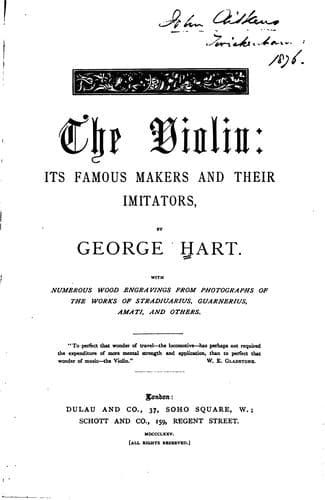
The Violin: Its Famous Makers and Their ImitatorsHart, George
History
The Violin: Its Famous Makers and Their Imitators
Hart, George
Violin -- History; Violin makers -- Biography
Upon the strings of the Violin depends in a great measure the
successful regulation of the instrument. If, after the careful
adjustment of bridge, sound-post, and bass-bar, strings are added
which have not been selected with due care and regard to their
relative proportion, the labour expended upon the important parts
named is at once rendered useless. Frequently the strings are the
objects least considered when the regulation of a Violin is attempted;
but if this be the case, results anything but satisfactory ensue. It
is, therefore, important that every Violinist should endeavour to make
himself acquainted with the different varieties and powers of strings,
that he may arrange his instrument with due facility.
The remarkable conservatism attending the structural formation of the
Violin exists more or less in the appliances necessary for the
awakening of its dormant music. If we turn to its pegs, we find them
of the same character as the peg of its far-removed ancestor, the
monochord; and if we compare the Italian peg of the seventeenth
century with a modern one, the chief difference lies in the latter
being more gross and ugly. Upon turning to the bridge, we see that the
bridge of to-day is almost identical with the bridge of Stradivari;
and when we come to the strings of the Violin, we discover that we
have added but little, if anything, to the store of information
regarding them possessed by our forefathers.
In, perhaps, the earliest book on the Lute, that of Adrian Le Roy,
published in Paris in 1570, and translated into English in 1574,[1] we
read: "I will not omit to give you to understand how to know strings."
"It is needful to prove them between the hands in the manner set forth
in the figures hereafter pictured, which show on the finger and to the
eye the difference from the true with the false." The instructions
here given, it will be seen, are those set forth by Louis Spohr in his
"Violin School." In the famous musical work of Merseene, published in
1648, we find an interesting account of strings; he says they are of
"metal, and the intestines of sheep." "The thicker chords of the great
Viols and of Lutes are made of thirty or forty single intestines, and
the best are made in Rome and some other cities in Italy. This
superiority is owing to the air, the water, or the herbage on which
the sheep of Italy feed." He adds that "chords may be made of silk,
flax, or other material," but that "animal chords are far the best."
The experience of upwards of two centuries has not shaken the
soundness of Merseene's opinion of the superiority of gut strings over
those made of silk and steel. Although strings of steel and silk are
made to some extent on account of their durability and their fitness
for warm climates, no Violinist familiar with the true quality of tone
belonging to his instrument is likely to torture his ears with the
sound of strings made with thread or iron. Continuing our inquiries
Public-domain text, read in full here on John Shaqi.
Reviews
Reviews
No reviews yet
Be the first to share your thoughts on this work.
Join the Discussion
Join the discussion
Sign in to leave a comment or review.
Sign InorCreate an account