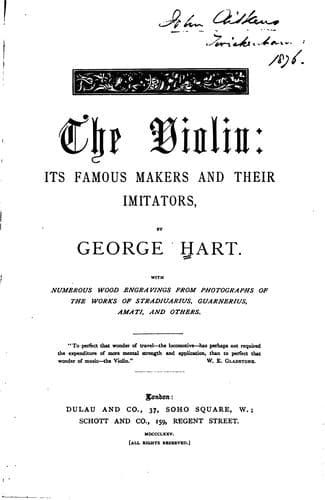
The Violin: Its Famous Makers and Their ImitatorsHart, George
History
The Violin: Its Famous Makers and Their Imitators
Hart, George
Violin -- History; Violin makers -- Biography
Endeavour to obtain strings of uniform thickness throughout, a
requisite which can only be insured by careful gauging. In selecting
the E string, choose those that are most transparent; the seconds and
thirds, as they are made with several threads, are seldom very clear.
The firsts never have more than a few threads in them, and hence,
absence of transparency in their case denotes inferior material.
Before putting on the first string, in particular, in order to test
its purity it will be well to follow Le Roy's advice, which is to hold
between the fingers of each hand a portion of the string sufficient to
stretch from the bridge to the nut, and to set it in vibration. If two
lines only be apparent, the string is free from falseness; but if a
third line be produced, the contrary conclusion must be assumed. In
the case of seconds and thirds we cannot always rely on this test, as
the number of threads used in their manufacture frequently prevents
the line from being perfectly clear. The last precaution of moment is
to secure perfect fifths, which can only be done by taking care that
the four strings are in true proportion and uniform with each other.
To string a violin correctly is a very difficult undertaking, and
requires considerable patience. The first consideration should be the
constitution of the Violin: the strings that please one instrument
torture another. Neither Cremonese Violins nor old instruments in
general require to be heavily strung: the mellowness of the wood and
their delicate construction require the stringing to be such as will
assist in bringing out that richness of tone which belongs to
first-rate instruments. If the bridge and sound-board be heavily
weighted with thick strings, vibration will surely be checked. In the
case of modern instruments, heavy in wood, and needing constant use to
wear down their freshness, strings of a larger size may be used with
advantage, and particularly when such instruments are in use for
orchestral purposes.
[Illustration: _Plate III_. VIOLONCELLO BY ANTONIO STRADIVARI.
PRESENTED TO SIGNOR PIATTI BY GENERAL OLIVER. (Herr Robert
Mendelssohn.)]
Public-domain text, read in full here on John Shaqi.
Reviews
Reviews
No reviews yet
Be the first to share your thoughts on this work.
Join the Discussion
Join the discussion
Sign in to leave a comment or review.
Sign InorCreate an account