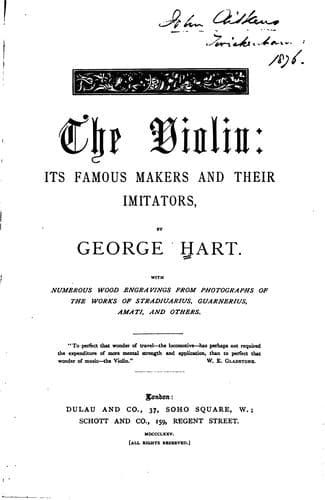
The Violin: Its Famous Makers and Their ImitatorsHart, George
History
The Violin: Its Famous Makers and Their Imitators
Hart, George
Violin -- History; Violin makers -- Biography
Vast improvements have been effected in the stringing of Violins
within the last thirty years. Strings of immense size were used alike
on Violins, Violoncellos, Tenors, and Double Basses. Robert Lindley,
the king of English Violoncellists, used a string for his first very
nearly equal in size to the second of the present time, and the same
robust proportion was observed in his other strings. The Violoncello
upon which he played was by Forster, and would bear much heavier
stringing than an Italian instrument; and, again, he was a most
forcible player, and his power of fingering quite exceptional.
Dragonetti, the famous Double-Bass player, and coadjutor of Lindley,
possessed similar powers, and used similar strings as regards size.
Their system of stringing was adopted indiscriminately. Instruments
whether weakly or strongly built received uniform treatment, the
result being in many cases an entire collapse, and the most
disappointing effects in tone. It was vainly supposed that the
ponderous strings of Dragonetti and Lindley were the talisman by use
of which their tone would follow as a matter of course, whereas in
point of fact it was scarcely possible to make the instruments utter a
sound when deprived of the singular muscular power possessed by those
famous players. After Lindley's death his system passed away
gradually, and attention was directed to the better adaptation of
strings to the instrument, and also to the production of perfect
fifths.
We have now only to speak of covered strings, in which it is more
difficult to obtain perfection than in the case of those of gut. There
are several kinds of covered strings. There are those of silver wire,
which are very durable, and have a soft quality of sound very suitable
to old instruments, and are therefore much used by artistes; there are
those of copper plated with silver, and also of copper without
plating, which have a powerful sound; and, lastly, there are those
which are made with mixed wire, an arrangement which prevents in a
measure the tendency to rise in pitch, a disadvantage common to
covered strings and caused by expansion of the metals; these strings
also possess a tone which is a combination of that produced by silver
and copper strings. Here again, however, great discrimination is
needed, viz., before putting on the fourth string. The instrument must
be understood. There are Violins which will take none but fourths of
copper, there are others that would be simply crippled by their
adoption. It cannot be too much impressed upon the mind of the player
that the Violin requires deep and patient study with regard to every
point connected with its regulation. So varied are these instruments
in construction and constitution, that before their powers can be
successfully developed they must be humoured, and treated as the child
of a skilful educator, who watches to gain an insight into the
character of his charge, and then adopts the best means for its
Public-domain text, read in full here on John Shaqi.
Reviews
Reviews
No reviews yet
Be the first to share your thoughts on this work.
Join the Discussion
Join the discussion
Sign in to leave a comment or review.
Sign InorCreate an account