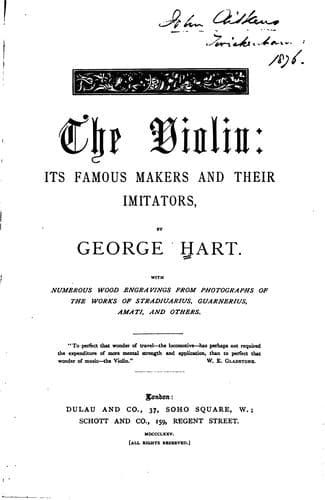
The Violin: Its Famous Makers and Their ImitatorsHart, George
History
The Violin: Its Famous Makers and Their Imitators
Hart, George
Violin -- History; Violin makers -- Biography
[Footnote 1: The importance of this epoch in its bearings upon
instrumental music generally, and stringed instrument music in
particular, can hardly be over-estimated. It may be said that in the
Middle Ages no written music for instruments existed. The melodies and
accompaniments produced from instruments were either extemporaneous or
parrot-like imitations of vocal music. Madrigals and a few dances
constituted the food upon which instruments were nursed until towards
the close of the sixteenth century, when Gabrielli, or a contemporary
musician, prepared a special and distinct aliment, the outcome of
which is found in the symphonies of Haydn, Mozart, and Beethoven.]
If we turn to the days of Gasparo da Salo, Maggini, and Andrea Amati,
we find that while they were sending forth their Fiddles, Titian was
painting his immortal works, and Benvenuto Cellini, the greatest
goldsmith of his own or any age, was setting the jewels of popes and
princes, and enamelling the bindings of their books. Whilst the
master-minds of Antonio Stradivari and Giuseppe Guarneri del Gesu were
occupied with those instruments which have caused their names to be
known throughout the civilised world (and _un_civilised too, for many
thousands of Violins are yearly made into which their cherished names
are thrust, after which they are despatched for the negro's use),
Canaletto was painting his Venetian squares and canals, Venetians
whose names are unrecorded were blowing glass of wondrous form and
beauty. At the same time, in the musical world, Corelli was writing
his jigs and sarabands, Geminiani penning one of the first instruction
books for the Violin, and Tartini dreaming his "Sonata del Diavolo";
and while Guadagnini and the stars of lesser magnitude were exercising
their calling, Viotti, the originator of a school of Violin-playing,
was writing his concertos, and Boccherini laying the foundation of
classical chamber-music of a light and pleasing character. It would be
easy to continue this vein of thought, were it not likely to become
irksome to the reader; enough has been said to refresh the memory as
to the flourishing state of Italian art during these times. What a
mine of wealth was then opened up for succeeding generations! and how
curious is the fact that not only the Violin, but its music, has been
the creature of the most luxurious age of art; for in that golden age
musicians contemporary with the great Violin-makers were writing music
destined to be better understood and appreciated when the Violins then
made should have reached their maturity.
Public-domain text, read in full here on John Shaqi.
Reviews
Reviews
No reviews yet
Be the first to share your thoughts on this work.
Join the Discussion
Join the discussion
Sign in to leave a comment or review.
Sign InorCreate an account