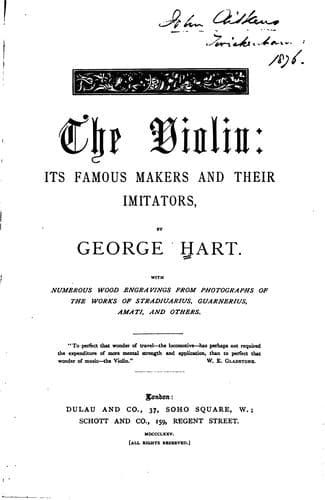
The Violin: Its Famous Makers and Their ImitatorsHart, George
History
The Violin: Its Famous Makers and Their Imitators
Hart, George
Violin -- History; Violin makers -- Biography
The fifteenth century may be considered as the period when the art of
making instruments of the Viol class took root in Italy, a period rich
in men labouring in the cause of Art. The long list of honoured names
connected with Art in Italy during the fifteenth, sixteenth, and
seventeenth centuries is a mighty roll-call indeed! The memory dwells
upon the number of richly-stored minds that have, within the limits of
these three centuries, bequeathed their art treasures to all time; and
if here we cannot suppress a comparison of the art world of the
present Italy with that of the periods named, still less can we fail
to be astonished as we discover the abyss into which Italy must be
judged to have sunk in point of merit, when measured by the high
standard which in former days she set herself. But perhaps the
greatest marvel of all is the rapidity of the decadence when it once
set in, as it did immediately after the culminating point of artistic
fame had been reached.
To reflect for a moment upon the many famous men in Italy engaged in
artistic vocations contemporary with the great Viol and Violin makers
cannot fail to be interesting to the lovers of our instrument, for it
has the effect of surrounding their favourite with an interest
extending beyond its own path. It also serves to make prominent the
curious fact that the art of Italian Violin-making emerged from its
chrysalis state when the painters of Italy displayed their greatest
strength of genius, and perfected itself when the Fine Arts of Italy
were cast in comparative darkness. It is both interesting and
remarkable that the art of Italian Violin-making--which in its infancy
shared with all the arts the advantage attending the revival of art
and learning--should have been the last to mature and die.
Whilst the artist, scientist, and musician, Leonardo da Vinci, was
painting, inventing, and singing his sonnets to the accompaniment of
his Lute; whilst Raphael was executing the commands of Leo X., and
Giorgio was superintending the manufacture of his inimitable majolica
ware, the Viol-makers of Bologna were designing their instruments and
assimilating them to the registers of the human voice, in order that
the parts of Church and chamber madrigals might be played instead of
sung, or that the voices might be sustained by the instruments.[1]
Public-domain text, read in full here on John Shaqi.
Reviews
Reviews
No reviews yet
Be the first to share your thoughts on this work.
Join the Discussion
Join the discussion
Sign in to leave a comment or review.
Sign InorCreate an account