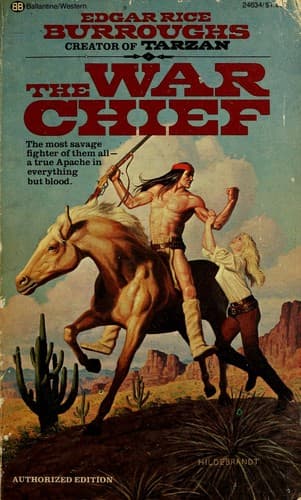
Apache Indians -- Fiction; Historical fiction; Western stories
“Do not again tell him that he is white,” said Cochise to Juh. “Some day
soon he will be a warrior and if he thinks that he is white it will make
his heart like water against the enemies of our people.”
Shoz-Dijiji did not return to the women and children. His heart was in
no mood for play nor for any of the softer things of life. Instead he
walked alone out of the camp and up a gaunt, parched canyon. He moved as
noiselessly as his own shadow. His eyes, his ears, his nostrils were
keenly alert, as they ever were, for Shoz-Dijiji was playing a game that
he always played even when he seemed to be intent upon other things—he
was hunting the white soldiers. Sometimes, with the other boys, he
played that they were raiding a Mexican rancheria, but this sport
afforded him no such thrill as did the stalking of the armed men who
were always hunting his people.
He had seen the frightened peons huddled in their huts, or futilely
running to escape the savage, painted warriors who set upon them with
the fury of demons; he had seen the women and children shot, or stabbed,
or clubbed to death with the men; he had seen all this without any
answering qualm of pity; but it had not thrilled him as had the
skirmishes with the soldiers of Mexico and the United States—ah, there
was something worthy the mettle of a great warrior!
From infancy he had listened to the stories of the deeds of the warriors
of his people. He had hung breathless upon the exploits of Victorio, of
Mangas Colorado, of Cochise. For over three hundred years his people had
been at war with the whites; their lands had been stolen, their
warriors, their women and their children had been ruthlessly murdered;
they had been treated with treachery; they had been betrayed by false
promises.
Shoz-Dijiji had been taught to look upon the white man not only as a
deadly enemy, but as a coward and a liar; even as a traitor to his
fellow whites, for it was not unknown to this little Apache boy that
there were many white men who made a living selling rifles and
ammunition to the Indians while their own troops were in the field
against them. It was no wonder Shoz-Dijiji held the whites in contempt,
or that to be called white was the bitterest insult that could be placed
upon him.
Today, as he moved silently up the sun-scorched canyon he was thinking
of these things and listening, listening, always listening. Perhaps he
would hear the distant thud of iron-shod hoofs, the clank of a saber,
and be the first to warn his people of the approaching enemy. He knew
that there were scouts far afield—eagled-eyed men, past whom not even
klij-litzogue, the yellow snake, could glide unseen; yet he loved to
dream, for he was a boy.
The dreaming that Shoz-Dijiji practiced did not dull his senses; on the
contrary it was thus that he made them more alert, for he lived his
dreams, rehearsing always the part of the great warrior that he hoped
some day to play upon the stage of life, winning the plaudits of his
fellows.
Public-domain text, read in full here on John Shaqi.
Reviews
Reviews
No reviews yet
Be the first to share your thoughts on this work.
Join the Discussion
Join the discussion
Sign in to leave a comment or review.
Sign InorCreate an account