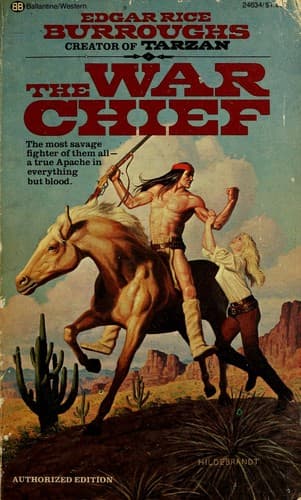
Apache Indians -- Fiction; Historical fiction; Western stories
“Among the Be-don-ko-hes killed then were San-za, Kla-de-ta-he,
Ni-yo-ka-he and Go-pi. Remember these names and when you see a white man
think of them and revenge them.”
It was another day. The squaws brewed tizwin. In a group sat the
warriors and the chiefs. Go-yat-thlay was still boasting about the
exploit of his little Shoz-Dijiji.
“He will make a great warrior,” said he to Cochise, hereditary chief of
the Cho-kon-en and war chief of all the Apaches. “I knew it from the
first, for when he was taken from the wagon of his people he did not
cry, although Juh dragged him out by one leg and held him with his head
down. He did not cry then; he has never cried since.”
“He is the child of the white man,” growled Juh. “He should have been
killed.”
“He looked like one of us, like a Shis-Inday,” replied Go-yat-thlay.
“Long time after I learned at the agency, when we had come back from
Sonora, that his mother was a white woman.”
“You know it now,” said Juh.
A terrible expression crossed the cruel face of Go-yat-thlay. He leaped
to his feet, whipping out his knife as he arose. “You talk much, Juh, of
killing Shoz-Dijiji,” he said in a low voice. “Ten times have the rains
come since first you would have killed him and you are still talking
about it. Now you may kill him; but first you must kill Go-yat-thlay!”
Juh stepped back, scowling. “I do not wish to kill Shoz-Dijiji,” he
said.
“Then keep still. You talk too much—like an old woman. You are not
Naliza; when Naliza talks he says something.” Go-yat-thlay slipped his
knife into his belt and squatted again upon his heels. With silver
tweezers he plucked the hairs from about his mouth. Cochise and Naliza
laughed, but Juh sat there frowning. Juh! that terrible man who was
already coming to be known as “the butcher.”
Shoz-Dijiji, from the interior of his father’s hut, heard this talk
among his elders and when Go-yat-thlay sprang to his feet and
Shoz-Dijiji thought that blood would be spilled he stepped from the
doorway, in his hands a mesquite bow and a quartz-tipped arrow. His
straight, black hair hung to his shoulders, his brown hide was
sun-tanned to a shade even deeper than many of his full-blood Apache
fellows. The trained muscles of his boyish face gave no hint of what
emotions surged within him as he looked straight into Juh’s eyes.
“You lie, Juh,” he said; “I am not a white-eyes. I am the son of
Go-yat-thlay. Say that I am not a white, Juh!” and he raised his arrow
to a level with the warrior’s breast. “Say that he is not white or
Shoz-Dijiji will kill you!”
Cochise and Naliza and Go-yat-thlay, grinning, looked at Juh and then
back at Shoz-Dijiji. They saw the boy bend the bow and then Cochise
interfered.
“Enough!” he said. “Go back to the women and the children, where you
belong.”
The boy lowered his weapon. “Cochise is chief,” he said. “Shoz-Dijiji
obeys his chief. But Shoz-Dijiji has spoken; some day he will be a
warrior and then he will kill Juh.” He turned and walked away.
Public-domain text, read in full here on John Shaqi.
Reviews
Reviews
No reviews yet
Be the first to share your thoughts on this work.
Join the Discussion
Join the discussion
Sign in to leave a comment or review.
Sign InorCreate an account