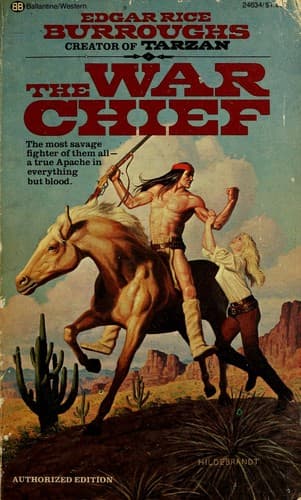
Apache Indians -- Fiction; Historical fiction; Western stories
For a moment Juh was silent. “It shall be as Shoz-Dijiji says,” he
growled presently, “so long as no one knows of this thing that has just
happened, other than Juh and Shoz-Dijiji. Juh has spoken—that is all!”
“Come forth, then, Juh, and go your way,” said the boy; “but remember
they must be good ponies.”
He stood aside as the warrior strode from the hogan, and he was careful
to stand out of the man’s reach and to keep his weapon in readiness, for
after all he had no great confidence in the honor of Juh.
CHAPTER III
YAH-IK-TEE
ANOTHER year rolled around. Once again were the Be-don-ko-he, the
Cho-kon-en and the Ned-ni camped together and with them were the
Chi-hen-ne, with Victorio, old Nanáy and Loco. Together they had been
raiding in Chihuahua and Sonora. It had been a prosperous year for the
tribes, a year rich in loot; and for little Shoz-Dijiji it had been a
wonderful year. Bright, alert, he had learned much. He had won a name
and that had helped him too, for the other boys looked up to him and
even the great chiefs took notice of him.
Cochise had developed a real affection for the stalwart youngster, for
he saw in a lad who could face fearlessly a renowned chief such as Juh
was, even at that time, a potential leader of his people in the years to
come.
Often the old war chief talked to Shoz-Dijiji of the exploits of his
people. He told him of the many wars with the Comanches and the Navajos,
of raids upon the villages of the Pimos and the Papagos; and he filled
his heart with yearning to emulate the glorious deeds of the great
warriors who had made terrible the name of the Apaches, the Shis-Inday,
the Men of the Woods, from the Arkansas River in Colorado on the north,
south to Durango, Mexico, more than five hundred miles below the border;
and from the California line on the west to San Antonio, Texas, on the
east—an empire as large as Europe.
“And of all this, I, Cochise, am war chief,” cried the old warrior.
“Soon you will be a brave. So fight that you will fill our enemies with
fear and our warriors with admiration so that, perhaps, you some day may
be war chief of all the Apaches.”
It was May. Flowers starred the rolling pasture land, green with grama
grass on which the ponies were fattening after the gruelling months of
raiding south of the border. The braves loafed much about the camp,
smoking and gambling. The squaws and the children tilled a little patch
of ground, and once again some of the women brewed tizwin, for there was
to be a great dance before the tribes scattered to their own countries.
The crushed corn had been soaked and was fermenting; the mescal was
roasting upon hot stones in its pit; a Yuma squaw, a prisoner of war,
was making a paste of soaked maize in a metate. The paste she patted
into thin, round cakes and baked.
Public-domain text, read in full here on John Shaqi.
Reviews
Reviews
No reviews yet
Be the first to share your thoughts on this work.
Join the Discussion
Join the discussion
Sign in to leave a comment or review.
Sign InorCreate an account