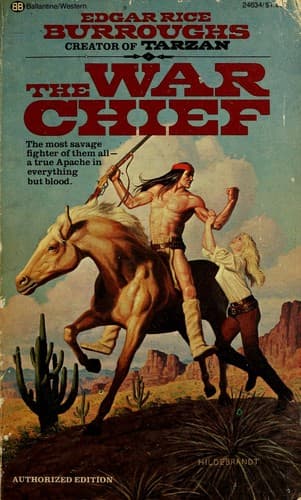
Apache Indians -- Fiction; Historical fiction; Western stories
Already he was leaping swiftly down the mountainside. Speed, now, meant
everything and he was less careful of concealment, yet neither did he
entirely neglect it, for to the Apache it was second nature. He did not
fear detection by the main body of the enemy, but he knew that they
might have scouts far out in front, though his keen eyes had seen
nothing of them. With streaming hair the boy flew down the steep
declivity, as trailless as the Mountains of the Moon. If he could reach
camp ten minutes ahead of the enemy his people would be saved. He knew
that he could do so; there was no guess work about it.
The warriors were, for the most part, sleeping off the effects of the
tizwin. Some were gambling. Others were still quarrelling. The squaws,
as usual, were working, caring for their babies, cooking food, preparing
hides, gathering firewood, carrying water. The bosom friends, Victorio
and Go-yat-thlay, were emerging from the shelter of Cochise, who was
still very sick, when Shoz-Dijiji bounded into camp and ran directly to
the two chiefs.
“Soldiers!” he said, and pointed down toward the plain. “From the
mountaintop Shoz-Dijiji saw them. There are many soldiers and they come
on horses. There is yet time, if you make haste, to hide warriors on
either side of the canyon before the pindah lickoyee pass through.”
The chiefs asked him a few brief questions, then they ran quickly
through the camp calling the warriors to arms. There was little noise,
but there seemed to be a great deal of confusion. The squaws gathered up
their few belongings preparatory to taking to the mountains if hard
pressed. The warriors caught up their weapons and gathered around their
chiefs; the Be-don-ko-he around Go-yat-thlay; the Chi-hen-ne, or Warm
Springs Apaches, around Victorio; the Chi-e-a-hen to Co-si-to; the White
Mountain Apaches to Hash-ka-ai-la; the Ned-ni to Juh; and the
Cho-kon-en, or Chihuicahui, to Na-chi-ta, the son of Cochise.
There was hasty daubing of paint on swart faces as the chiefs led them
out from camp to take the places that Go-yat-thlay, acting war chief,
had allotted to each tribe. Stripped to loin cloth, moccasins and head
band or kerchief the fighting men of the Apaches moved silently down
among the cedars to their positions. Ahead of them Go-yat-thlay had sent
scouts to ascertain the position of the enemy and before the warriors
reached the place of ambush one of these had returned to say that the
soldiers were but a mile from the lower mouth of the canyon.
Public-domain text, read in full here on John Shaqi.
Reviews
Reviews
No reviews yet
Be the first to share your thoughts on this work.
Join the Discussion
Join the discussion
Sign in to leave a comment or review.
Sign InorCreate an account