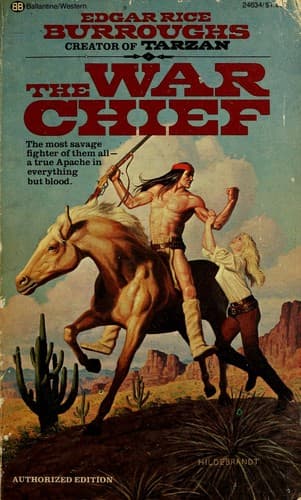
Apache Indians -- Fiction; Historical fiction; Western stories
From the headwaters of the Gila far south into the Sierra Madre
mountains in Mexico, Shoz-Dijiji already knew every canyon, every peak,
every vantage point. He knew where water ran or stood the year round; he
knew where it stood after each rain and for how long; he knew where one
might discover it by scratching in the bed of a dry stream, and where
one must dig deep for its precious boon. This was but a fraction of the
countless things that Shoz-Dijiji knew about his own country. He knew
nothing about Latin or Greek; he had never heard of Rome or Babylon; but
he could take care of himself better at eleven than the majority of
white men can at their prime and he had learned more useful things from
actual experience than the white boy ever learns.
Therefore, this day, though he played, he played with judgment, with
intelligence. He did not just fare forth and make believe that he was
scouting for an enemy—he did scout. He moved to the best position
within a radius of fifty miles, and when he reached it he knew just
where to look for an enemy; he knew the trails they must follow to reach
his people’s camp; and the first thing that he saw when he looked toward
the south, toward Sonora, toward the land of their hereditary enemies,
brought a wave of savage exultation surging through his brown body.
There on the plain, twenty miles away, moving steadily toward the camp
of the Shis-Inday was a long column of dust. All the six tribes lay
unsuspecting below him, so it would not be Apaches that were advancing
toward them, and if it were not Apaches it must be an enemy. His eyes
were keen, but the column was enveloped in dust; however, he was
confident from the formation that he was looking at a body of mounted
troops.
For just an instant longer he watched them, while he revolved in his
mind the plan of action best to follow. The enemy was ten miles south of
camp, Shoz-Dijiji was ten miles north. They were mounted but it would
take them longer to ascend the rocky trail than it would take
Shoz-Dijiji to descend the mountain and give the warning; otherwise he
would have resorted to smoke signals to apprise his people of their
danger. That he might still do, but the enemy would see the signals,
too, and know that the Indians were near and aware of their presence.
Shoz-Dijiji pictured instead a surprise ambush in a narrow canyon just
below the Apaches’ camp.
Public-domain text, read in full here on John Shaqi.
Reviews
Reviews
No reviews yet
Be the first to share your thoughts on this work.
Join the Discussion
Join the discussion
Sign in to leave a comment or review.
Sign InorCreate an account