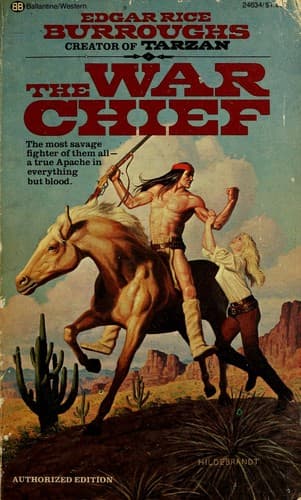
Apache Indians -- Fiction; Historical fiction; Western stories
But ever in the seed of the savage is the germ of savagery that no
veneer of civilization, no stultifying inhibitions seem able ever
entirely to eradicate. Appearing sporadically in individuals it comes
down the ages—the germ of savagery, the seed of freedom.
As the Caledonian savages danced through that long-gone night, a
thousand years, perhaps, before the prototypes of Joseph Smith, John
Alexander Dowie and Aimee Semple McPherson envisaged the Star of
Bethlehem, a new sun looked down upon the distant land of the
Athapascans and another scene—American Indian savages.
Naked but for a G-string, rough sandals, a bit of hide and a buffalo
headdress, a savage warrior moved silently among the boles of great
trees. At his heels, in single file, came others, and behind these
squaws with papooses on their backs and younger children tagging at
their heels.
They had no pack animals, other than the squaws, but they had little to
pack. It was, perhaps, the genesis of that great trek toward the south.
How many centuries it required no man knows, for there were no
chroniclers to record or explain that long march of the Apaches from
northwest Canada to Arizona and New Mexico, as there have been to trace
the seed of the Caledonian savage from the Grampian Hills to the New
World.
The ancestors of Jerry MacDuff had brought the savage germ with them to
Georgia from Scotland in early colonial days, and it had manifested
itself in Jerry in two ways—filled him with a distaste for civilization
that urged him ever frontierward and mated him with the granddaughter of
a Cherokee Indian, in whose veins pulsed analogous desires.
Jerry MacDuff and Annie Foley were, like nearly all other pioneers,
ignorant, illiterate, unwashed. They had nothing of the majesty and
grandeur and poise of their savage forebears; the repressive force of
civilization had stifled everything but the bare, unlovely germ of
savagery.
They have little to do with this chronicle, other than to bring Andy
MacDuff into the world in a dilapidated wagon somewhere in Missouri in
the spring of 1863, and carry him a few months and a few hundred miles
upon the sea of life.
Why Jerry MacDuff was not in one army or another, or in jail, in 1863, I
do not know, for he was an able-bodied man of thirty and no coward; but
the bare fact is that he was headed for California along the old Santa
Fe trail. His pace was slow, since dire poverty, which had always been
his lot, necessitated considerable stops at the infrequent settlements
where he might earn the wherewith to continue his oft-interrupted
journey.
Out of Santa Fe, New Mexico, the MacDuffs turned south along the Rio
Grande toward the spot where the seeds of the ancient Caledonian and
Athapascan warriors were destined to meet again for the first time,
perhaps, since they had set out upon opposite trails from the birthplace
of humanity in the days when ferns were trees, and unsailed seas lashed
the shores of continents that are no more.
Public-domain text, read in full here on John Shaqi.
Reviews
Reviews
No reviews yet
Be the first to share your thoughts on this work.
Join the Discussion
Join the discussion
Sign in to leave a comment or review.
Sign InorCreate an account