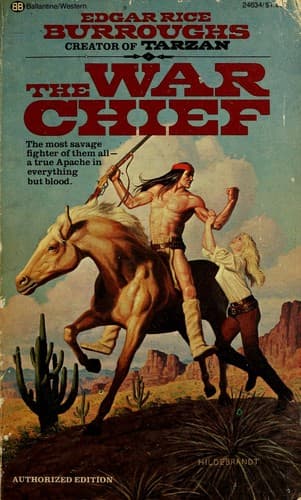
Apache Indians -- Fiction; Historical fiction; Western stories
Changed are the seas, changed are the continents, changed the mortal
envelope that houses the germ of humanity that alone remains unchanged
and unchangeable. It abode in the breast of Go-yat-thlay, the Apache
and, identical, in the breast of Andy MacDuff, the infant white.
Had Andy’s forebears remained in Scotland Andy would doubtless have
developed into a perfectly respectable caddie before he became a
God-fearing, law-abiding farmer. Back of him were all the generations of
civilization that are supposed to have exerted a refining influence upon
humanity to the end that we are now inherently more godlike than our
savage ancestors, or the less-favored peoples who have yet to emerge
from savagery.
Back of Go-yat-thlay there was no civilization. Down through all the
unthinkable ages from the beginning the savage germ that animated him
had come untouched by any suggestion of refinement—Go-yat-thlay, born a
Ned-ni Apache in No-doyohn Canyon, Arizona, in 1829, was stark savage.
Already, at thirty-four, he was war chief of the Be-don-ko-he, the tribe
of his first wife, Alope, which he had joined after his marriage to her.
The great Mangas Colorado, hereditary chief of the Be-don-ko-he, thought
well of him, consulted him, deferred to him upon occasion; often sent
him out upon the war trail in command of parties of raiders.
Today Go-yat-thlay was thus engaged. With four warriors he rode down the
slopes of Stein’s Peak range, dropped into a hollow and clambered again
almost to the top of an eminence beyond. Here they halted and
Go-yat-thlay, dismounting, handed his reins to one of his fellows. Alone
he clambered noiselessly to the summit, disturbing no smallest pebble,
and lying there upon his belly looked down upon a winding, dusty road
below. No emotion that he may have felt was reflected in those cruel,
granitic features.
For an hour he had been moving directly toward this point expecting that
when he arrived he would find about what he was looking down upon now—a
single wagon drawn by two mules, a dilapidated wagon, with a soiled and
much-patched cover.
Go-yat-thlay had never before seen this wagon, but he had seen its dust
from a great distance; he noted its volume and its rate of progress, and
he had known that it was a wagon drawn by two mules, for there was less
dust than an ox-drawn vehicle would have raised, since oxen do not lift
their feet as high as horses or mules, and, too, its rate of progress
eliminated oxen as a possible means of locomotion. That the wagon was
drawn by mules rather than horses was but a shrewd guess based upon
observation. The Apache knew that few horses survived thus far the long
trek from the white man’s country.
Public-domain text, read in full here on John Shaqi.
Reviews
Reviews
No reviews yet
Be the first to share your thoughts on this work.
Join the Discussion
Join the discussion
Sign in to leave a comment or review.
Sign InorCreate an account