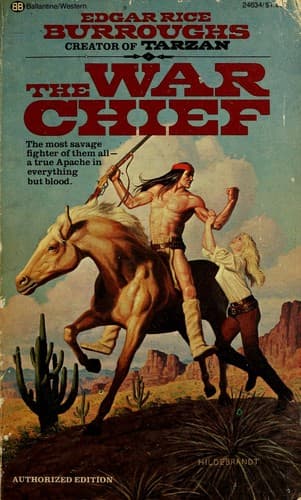
Apache Indians -- Fiction; Historical fiction; Western stories
It was several minutes before the lad opened his eyes. Beside him lay
the dead body of shoz-dijiji; the last arrow had penetrated his savage
heart. The son of Go-yat-thlay sat up and a broad smile illumined his
face. He rose to his feet and executed a war dance around the body of
his vanquished foe, bending to the right and left, backward and forward
until his body was parallel with the ground; now leaping high in air,
now stepping with measured tread, he circled the dead bear time and time
again. Fierce shouts rose to his lips, but he held them in check for he
knew that the white soldiers were searching for his people.
Suddenly he stopped dancing and looked down at shoz-dijiji, and then
glanced back along the trail toward the camp that was out of sight
beyond the many turns of the winding canyon. Then he stooped and tried
to lift the bear, but his young muscles were not equal to the effort.
Withdrawing his arrows from the bear’s body and recovering his bow he
clambered to the trail and set off at a brisk trot toward camp. He was
sore and lame and his head ached, but what matter? Never had he been
more happy.
As he entered the camp he was discovered by some playing children.
“Come, son of Go-yat-thlay!” they cried. “Come and play with us!” But
the son of Go-yat-thlay passed them haughtily. He went directly to where
several warriors were squatting, smoking, and waited until they noticed
him.
“Where is Go-yat-thlay?” he asked.
One of the warriors jerked a thumb down the canyon. “Go-yat-thlay hunts
antelope in the valley,” he said.
“I, the son of Go-yat-thlay,” said the boy, “have killed shoz-dijiji. I,
alone, shee-dah, have done this thing; but alone I cannot bring in my
kill. Therefore will you, Natch-in-ilk-kisn, come and help bring in the
body of shoz-dijiji, yah-tats-an?”
“You no kill shoz-dijiji, you lie,” said Natch-in-ilk-kisn. “You only
little ish-kay-nay.”
The lad drew himself up to his full height. “The son of Go-yat-thlay,
the chief, does not lie—to his friends,” he added. Then he pointed to
the scratches and the blood upon him. “Think you I got these playing tag
with the other children?” he asked. “The meat of shoz-dijiji is good.
Would Natch-in-ilk-kisn rather have the wolf, the coyote and the vulture
eat it than to eat it himself?”
The warrior rose. “Come, little ish-kay-nay,” he said, laughing.
“Natch-in-ilk-kisn joked. He will go with you.”
That night was a proud night for the son of Go-yat-thlay; for at the age
of ten he had killed big game and won a name for himself. Henceforth he
was to be known to man as Shoz-Dijiji, and not just as ish-kay-nay—boy.
He had had a name for a long time of course, but, also of course, no one
ever mentioned it in his presence, since if the bad spirits ever learned
his name they could, and undoubtedly would, cause him a great deal of
trouble, even to sickness and death.
Public-domain text, read in full here on John Shaqi.
Reviews
Reviews
No reviews yet
Be the first to share your thoughts on this work.
Join the Discussion
Join the discussion
Sign in to leave a comment or review.
Sign InorCreate an account