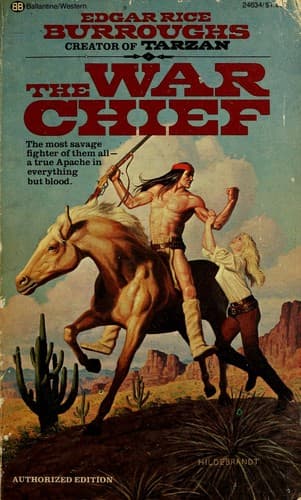
Apache Indians -- Fiction; Historical fiction; Western stories
Go-yat-thlay was not Go-yat-thlay’s name either, for he too, as all
other Apaches, had a secret name that was really his though no one ever
used it; and though he lived to be eighty years old and was better known
all over the world than any Indian who ever lived, with the possible
exception of the Sioux medicine man, Sitting Bull, yet to this day no
white man knows what his name was, and few indeed were those who knew
him even as Go-yat-thlay. By another name was he known, a name that the
Mexicans gave him, a name that held in fear and terror a territory into
which could have been dumped the former German Empire and all of Greece,
and still had plenty of room to tuck away Rhode Island—Geronimo.
That night Go-yat-thlay was proud, too, for Shoz-Dijiji was all that the
proudest Apache father could expect of any son; and according to the
custom of the Apaches the boy was as much the son of Go-yat-thlay as
though he had been the blood of his own blood.
Before the lad was sent to bed he sat at the knee of the grim chieftain
and the man stroked the boy’s head. “You will be a brave in no time,
Shoz-Dijiji,” he said. “You will be a warrior and a great one. Then you
can go forth and spread terror among the pindah lickoyee, slaying them
where you find them.”
“You hate the white-eyes,” said Shoz-Dijiji. “They are men like we; they
have arms and legs, as do we, and they walk and talk. Why do they fight
us? Why do we hate them?”
“Many years ago they came into our country and we treated them well,”
replied Go-yat-thlay. “There were bad men among them, but also there are
bad men among the Apaches. Not all men are good. If we killed their bad
men then they killed us. If some of our bad men killed some of them they
tried to punish all of us, not seeking out just the bad men among us who
had made the trouble; they killed us all, men, women and children, where
they found us. They hunted us as they would wild beasts.
“They took away our lands that Usen gave us. We were told that we could
not hunt where our fathers had hunted since the beginning of the world;
where we had always hunted. But they hunted there, where they would.
They made treaties with us and broke them. The white-eyed men do not
keep their promises and they are very treacherous. I will tell you now
of just a single instance that you may not forget the perfidy of the
white man and that you may hate him the more. This happened many years
ago, while Mangas Colorado was still living.
“Some of the chiefs of the white soldiers invited us to a council at
Apache Pass. Mangas Colorado, with many others, went, believing in the
good intentions of the white chiefs. Just before noon they were all
invited into a tent where they were told that they would be given food,
but instead they were set upon by the white soldiers. Mangas Colorado
drew his knife and cut his way through the side of the tent, as did
several other warriors, but many were killed and captured.
Public-domain text, read in full here on John Shaqi.
Reviews
Reviews
No reviews yet
Be the first to share your thoughts on this work.
Join the Discussion
Join the discussion
Sign in to leave a comment or review.
Sign InorCreate an account