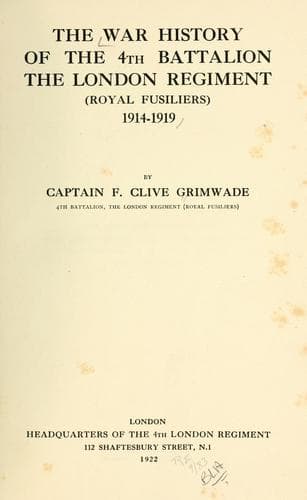
The War History of the 4th Battalion, the London Regiment (Royal Fusiliers), 1914-1919Grimwade, F. Clive
History
The War History of the 4th Battalion, the London Regiment (Royal Fusiliers), 1914-1919
Grimwade, F. Clive
Great Britain. Army. London Regiment. 4th (City of London) Battalion; World War, 1914-1918 -- Regimental histories -- Great Britain
The Battalion now settled down seriously to its training, and it was
found necessary to deal with some 250 men as recruits. These, however,
were passed through the Barrack Square stage of their training as
expeditiously as possible in view of the heavy duties which fell to the
Battalion in guarding the northern coast.
The guards found from the main body of the Battalion at Ghain Tuffieha
were mostly night guards at the landing-places, at St Paul's Bay on
the east coast, and at Ghain Tuffieha Bay, Karraba Ridge, and Gneina
Bay on the west coast. In addition to these, G and H companies were
immediately despatched on detachment, the former to Selmun Palace
(which commands the promontory between the shores of Melleha and
St Paul's Bays), the latter to Melleha (which dominates the head of
Melleha Bay and the Marfa Ridge beyond it). The latter detachment was
subsequently moved down the ridge to the coast near the head of Melleha
Bay. The guards found by these detached companies were at Cala Mistra
Fort (at the foot of Kalkara Ravine), Ir Razzet tal Blata, L'Imgiebah,
and Ghain Zeituna by the Selmun force; and at Melleha Bay, Torri
L'Ahmar cross roads, and Marfa Palace by the Melleha force.
The duties of the detached companies were found to be particularly
onerous, and the proportion of N.C.O.'s and men employed not only on
guards, but also on such necessary duties as signals, look-outs, and
water-carrying fatigues, continuously totalled rather more than a third
of the total strength of the detachments. Arrangements were therefore
made for the relief of the detachment companies every seven or eight
days, and this procedure was maintained throughout the Battalion's duty
on the island.
The training of the Battalion proceeded smoothly but under conditions
of some difficulty, partly owing to the number of men constantly
engaged in coastal defence duties, and partly owing to the unfavourable
conditions of terrain. Every square yard of the rocky hillsides which
is covered with soil is devoted to some sort of cultivation by the
thrifty inhabitants, and the walling up of the soil on the hillsides,
which has already been alluded to, converts every hill into a series
of steps, over which manœuvres are both laborious and painful. In
spite of these obstacles, however, a good deal of useful work was
achieved, and the Battalion rapidly began to take shape as a useful
and well-disciplined unit. There can be no doubt that the experience
gained by all ranks in taking their share in ordinary garrison duties
at so early a stage in their embodied career proved of infinite value
later when the 1/4th Londons ultimately took their place in the
fighting line; and, moreover, the knowledge that they were subject to
the critical--and at that period not always sympathetic--surveillance
of the regular staff of the Fortress provided the strongest possible
incentive to all ranks to conduct themselves with credit to their
Regiment and to the Territorial Force.
Public-domain text, read in full here on John Shaqi.
Reviews
Reviews
No reviews yet
Be the first to share your thoughts on this work.
Join the Discussion
Join the discussion
Sign in to leave a comment or review.
Sign InorCreate an account