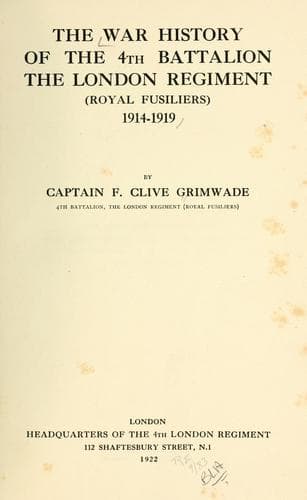
The War History of the 4th Battalion, the London Regiment (Royal Fusiliers), 1914-1919Grimwade, F. Clive
History
The War History of the 4th Battalion, the London Regiment (Royal Fusiliers), 1914-1919
Grimwade, F. Clive
Great Britain. Army. London Regiment. 4th (City of London) Battalion; World War, 1914-1918 -- Regimental histories -- Great Britain
Early in October a very thorough course of musketry instruction
under Fortress arrangements was begun, firing taking place on the
Naval ranges of Ghain Tuffieha. The companies were thus employed as
follows:--2 on detachment, 2 on musketry course, 3 on company training,
and 1 finding all the duties at Battalion Headquarters, the whole being
worked on a roster so that each company was kept for training and
detachment purposes at its greatest possible strength.
During the early days of the Battalion in Malta a few changes of
distribution took place among officers as follows:
Major R. J. J. Jackson was evacuated to Cottonera Hospital sick. He
unfortunately remained in hospital until early in December 1914,
when he was invalided to England. Command of F Company was taken by
Lieut. F. C. Grimwade, and the Machine-Gun Section was taken over by
2/Lieut. T. I. Walker, Lieut. S. Elliott transferring to E Company.
The Battalion was also joined by 2/Lieut. R. C. Kelly who, however,
remained with the unit for a few weeks only, at the end of which time
he was appointed to the Secret Service, and with this he remained until
the end of the War.
The middle of September, when the Battalion landed in Malta, found
the hot season waning, and although the temperature remained high
for some weeks the full intensity of the sub-tropical summer was not
experienced. In the early part of October, however, the scirocco, a
warm south-westerly wind which originates in the Sahara, followed, with
all its usual enervating effects, which were indeed quite as trying
as the intense heat of the sun had been. Towards the end of the same
month the wet season set in in earnest, and from that time until the
early part of December the camping ground at Ghain Tuffieha was swept
by tropical rains and sand storms of considerable violence, which from
time to time caused a certain amount of material damage and not a
little discomfort to the troops. The memory of suddenly having to turn
out and clear blocked drainage trenches and lay on to straining tent
ropes in the--sometimes--vain endeavour to prevent one's temporary home
from vanishing into thin air, and to rescue one's kit from a mud bath,
is now sufficiently remote to be contemplated without acute distress,
but the feelings which these encounters which the elements evoked at
the time were by no means so calm!
During the worst phase of the Malta climate the Battalion remained
under canvas, and it is of some interest--though admittedly of little
consolation--to remark that no battalion had previously spent the
winter in Malta in other than permanent barracks.
Thanks to the untiring efforts of the Battalion Medical Officer, Major
J. F. F. Parr, the bill of health during these marked variations of
climate remained extraordinarily clean, and in spite of its exposed
situation the Battalion suffered less from sickness than the others of
the Brigade which were accommodated in modern barracks.
Public-domain text, read in full here on John Shaqi.
Reviews
Reviews
No reviews yet
Be the first to share your thoughts on this work.
Join the Discussion
Join the discussion
Sign in to leave a comment or review.
Sign InorCreate an account