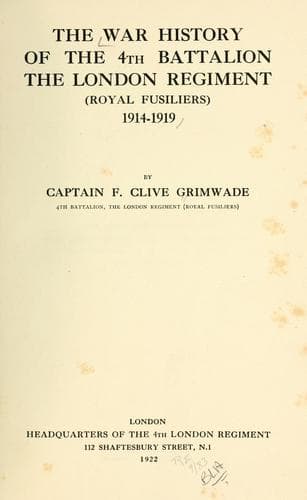
The War History of the 4th Battalion, the London Regiment (Royal Fusiliers), 1914-1919Grimwade, F. Clive
History
The War History of the 4th Battalion, the London Regiment (Royal Fusiliers), 1914-1919
Grimwade, F. Clive
Great Britain. Army. London Regiment. 4th (City of London) Battalion; World War, 1914-1918 -- Regimental histories -- Great Britain
The 168th Brigade group was disposed as follows:
HEADQUARTERS IN MARDI TRENCH
ASSAULTING BATTALIONS--
Right--London Scottish.
Left--Rangers.
SUPPORTING BATTALIONS--
Right--Kensingtons, with a special task of digging a
fire trench to form a defensive flank across
No Man's Land from the head of Welcome
Street.
Left--1/4th Londons.
168th M.G. Company--In tunnelled emplacements in the
WR line for overhead covering fire.
3-inch L.T.M. Battery (Stokes), (with half the 167th
Brigade Battery)--In emplacements in the
front line control trench.
In addition the following troops were at the disposal of the Brigadier
for the operation:
One Company 5th Cheshires (Pioneers).
One Section 2/2nd London Field Company, R.E.
Y 56--2-inch Mortar Battery.
The artillery affiliated to the Brigade consisted of four 18-pr.
batteries and one 4·5-inch howitzer battery, comprising the southern
group.
Similar attachments were made to the 167th Brigade, and over and above
these there remained at the disposal of the Divisional artillery,
a counter-battery group consisting of two 18-pr. and one 4·5-inch
howitzer batteries; and two 18-pr. batteries in reserve; while of
trench mortars there were one 2-inch battery (X 56) and two heavy
(9½-inch) mortars.
During the evening of the 30th June the other battalions of the Brigade
began to move into W sector to take up their assembly positions. The
assembly areas are marked on the map in Roman numerals as follows:
I. London Scottish (right front).
II. Rangers (left front).
III. Kensingtons (right support).
IV. 1/4th Londons (left support).
As each battalion arrived and took over its area the various companies
of the 1/4th Londons withdrew to No. IV area in rear of the Rangers.
In order to avoid congestion and cross traffic in the communication
trenches several platoons of the 1/4th Londons had to withdraw to
assembly position over the open, and by 10 p.m. this operation was
completed.
The 1st July was a glorious summer day, and the light haze which tells
of great heat hung over the rolling hills of this great plain which
was destined to become the scene of so great a struggle. With the
earliest grey of dawn the Germans opened an intense bombardment on all
our trenches, to which no reply was made by our artillery. This severe
shelling started at about 2.45 a.m. and lasted for nearly an hour: in
the course of it part of the Rangers were blown out of their assembly
trenches and compelled to make a temporary withdrawal to our area,
causing a good deal of congestion and confusion.
Public-domain text, read in full here on John Shaqi.
Reviews
Reviews
No reviews yet
Be the first to share your thoughts on this work.
Elsewhere in the archive
Join the Discussion
Join the discussion
Sign in to leave a comment or review.
Sign InorCreate an account