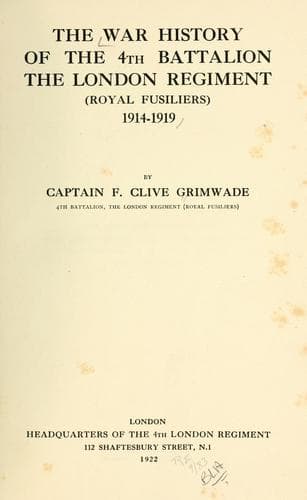
The War History of the 4th Battalion, the London Regiment (Royal Fusiliers), 1914-1919Grimwade, F. Clive
History
The War History of the 4th Battalion, the London Regiment (Royal Fusiliers), 1914-1919
Grimwade, F. Clive
Great Britain. Army. London Regiment. 4th (City of London) Battalion; World War, 1914-1918 -- Regimental histories -- Great Britain
The two platoons of B Company which went forward as clearing party were
severely handled. Both the subalterns, Chapman and Hicklenton, were hit
and only 10 men got back from the German line. 2/Lieut. A. S. Ford on
carrying party duty was also hit.
Of C Company only two platoons got forward as the order to advance
failed to reach Sykes, the company commander. But its casualties under
the terrific German barrage were as heavy as in any company, and after
Sykes had been wounded and both his subalterns, T. Moody and F. R. C.
Bradford, killed, the remnants of the company were brought steadily
out of action by Company Sergt.-Major Davis, who was rewarded with the
D.C.M.
D Company, which remained in reserve all day, had perhaps the most
trying time of all. From 2.30 a.m. until withdrawn at 3.30 p.m. it
sat still under the most intense artillery bombardment, but was kept
splendidly in hand and ready to move by Stanham and his only remaining
subaltern, G. H. Davis. B. F. L. Yeoman became a casualty early in the
day.
Of the Headquarters officers Major W. Moore and 2/Lieut. V. C.
Donaldson were wounded.
Magnificent work was done throughout the day by the Medical Officer,
Capt. Hurd, and his staff, who, though the number of casualties far
out-measured the facilities for dealing with them, continued their
work without a break throughout the day and the night following. In
this work splendid help was rendered by the Padre, Rev. R. Palmer, who
organised and led search and carrying parties in No Man's Land and
brought in many wounded who were unable to move.
The morning of the 2nd July was spent in the dreary duty of
ascertaining the casualties and reorganising the companies, and in the
afternoon the Battalion marched to billets at St Amand.
With the results of the day's fighting on other parts of the front
we are hardly concerned here. From Fricourt to the Somme the day was
successful and the bulk of the objectives were captured and held. But
from Fricourt northward the tale throughout was one of complete check.
Everywhere our troops met with initial success which everywhere was
later changed into disaster with appalling losses.
There is no doubt that in the northern half of attack the British
offensive was fully anticipated by the Germans. It would indeed have
been difficult to carry out such immense preparations over a period of
several weeks prior to the battle without permitting indications of the
impending attempt to become visible to hostile aerial scouts. But it
had been hoped that the weight and long continuance of the preliminary
bombardment, even though it disclosed its own purpose, would prove so
intense as to nullify all the German efforts to resist.
Public-domain text, read in full here on John Shaqi.
Reviews
Reviews
No reviews yet
Be the first to share your thoughts on this work.
Elsewhere in the archive
Join the Discussion
Join the discussion
Sign in to leave a comment or review.
Sign InorCreate an account