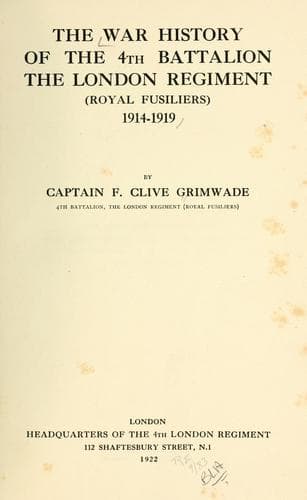
The War History of the 4th Battalion, the London Regiment (Royal Fusiliers), 1914-1919Grimwade, F. Clive
History
The War History of the 4th Battalion, the London Regiment (Royal Fusiliers), 1914-1919
Grimwade, F. Clive
Great Britain. Army. London Regiment. 4th (City of London) Battalion; World War, 1914-1918 -- Regimental histories -- Great Britain
We must here make some reference to the battle of the 46th Division on
the northern face of the Gommecourt salient. Against this ill-fated
Division the German fire was terrific. On the right the South Staffords
were completely shattered by the enemy's machine-guns before they could
cross No Man's Land; on the left the Sherwood Foresters succeeded in
gaining the German front line, and isolated parties appear even to
have struggled forward as far as the second trench, but were rapidly
ejected. Soon after zero the whole of the 46th Division's assaulting
troops were back in their own line after suffering appalling losses:
their attack was a complete failure. At the time, therefore, that the
56th Division was making headway into the German positions, instead of
the enemy feeling, as had been hoped, the pincers closing on him from
both sides of his salient, he was relieved from all menace on his right
flank facing the 46th Division, and free to throw the whole weight of
his artillery and infantry against the 56th Division.
But the causes of the 56th Division's failure must be looked for deeper
than this.
Primarily it may be said to have been due to the shortage of bombs.
The great distance which carrying parties had to traverse over No
Man's Land with fresh supplies and the intensity of the German barrage
through which they had to pass were both such that the facilities for
getting bombs forward were inadequate. It should be remembered that
the 168th and 169th Brigades captured three lines of German trenches
and held them against all attacks in spite of the gruelling enemy fire
for many hours. It was only when bomb supplies failed that they were
ejected.
There are three other factors in this battle to which we may refer as
having contributed to the failure.
First, the enormously strong deep dugouts in the German lines, which
were large enough to give shelter to the whole trench garrison except
the few necessary sentries, had proved too strong for all except the
heaviest guns; and those of the heaviest calibre had not been directed
against them. The German garrisons were therefore able to remain in
safety until the last moment when our barrage lifted off their front
lines and they were able to man their parapets. The strength of the
German defences was increased by the density and depth of their wire
entanglements, which had been most skilfully sited with the support of
machine-guns firing in enfilade.
Secondly, the insufficient attention paid on our side to
counter-battery work. The batteries told off for counter-battery fire
were too few and of too light calibre. Throughout the day the cry arose
from all Headquarters to silence the German guns, but the few batteries
available, though served magnificently by splendid gunners, could not
cope with so gigantic a task.
Public-domain text, read in full here on John Shaqi.
Reviews
Reviews
No reviews yet
Be the first to share your thoughts on this work.
Elsewhere in the archive
Join the Discussion
Join the discussion
Sign in to leave a comment or review.
Sign InorCreate an account