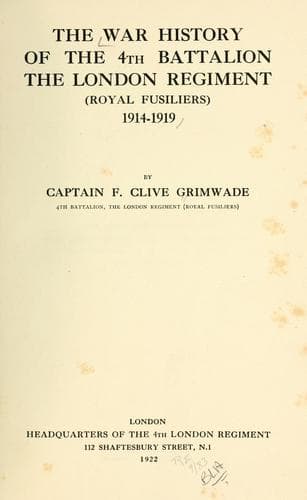
The War History of the 4th Battalion, the London Regiment (Royal Fusiliers), 1914-1919Grimwade, F. Clive
History
The War History of the 4th Battalion, the London Regiment (Royal Fusiliers), 1914-1919
Grimwade, F. Clive
Great Britain. Army. London Regiment. 4th (City of London) Battalion; World War, 1914-1918 -- Regimental histories -- Great Britain
Two tours of six days each were spent in this sector, broken by
six days--not of rest, but of most exhausting working parties--in
Riez Bailleul. The days in line saw a good deal of shelling and the
Battalion suffered some loss, but in spite of this and of exposure
to intense cold the men were probably more happy in the line than in
billets. Further heavy falls of snow had occurred. The working parties
supplied from Riez Bailleul were largely engaged in drawing trench
stores and material at a dump on the La Bassée Road between Pont du
Hem and Rouge Croix, itself nearly two miles from billets; and thence
pushing it up to the front trenches on the tram-line dignified with the
title of Great Eastern Railway, a further distance of upwards of 3000
yards. From railhead this material, consisting of trench boards, rolls
of barbed wire, revetting frames, hurdles and other heavy stuff had to
be distributed to companies in the line. These fatigues were obviously
exhausting, and seldom did a party leaving billets at 5.30 p.m. return
before midnight.
The most difficult task of all, however, which may not yet have quite
faded from the memories of many, was connected with an ingenious scheme
for draining the craters with heavy cast-iron water mains each about 16
feet long. With infinite labour these were brought to tram railhead,
but at this point the difficulty of carrying pipes, each weighing some
200 pounds, along 500 yards of quagmire proved too much even for the
stout hearts of Cockneys; and the high hopes which the author of the
scheme had entertained of draining the craters vanished as his pipes
sank in the mud. A change from this routine to the comparative peace of
trench mortaring in the line was not unwelcome.
An act of gallantry occurred during the first tour which must be
recorded. During one of the enemy's midday bombardments a time-fuzed
medium trench mortar shell fell on the parapet of our breastwork on the
lip of Mauquissart crater, and lodged in the revetting hurdle at the
side of the trench. The firebay happened to be crowded with men working
on the defences, and heavy casualties must inevitably have been caused
but for the bravery of 2/Lieut. W. H. Webster, who rushed forward and,
seizing the shell, flung it over the parapet into the crater, where
it immediately exploded. For this gallant action 2/Lieut. Webster was
awarded the D.S.O.
Public-domain text, read in full here on John Shaqi.
Reviews
Reviews
No reviews yet
Be the first to share your thoughts on this work.
Elsewhere in the archive
Join the Discussion
Join the discussion
Sign in to leave a comment or review.
Sign InorCreate an account