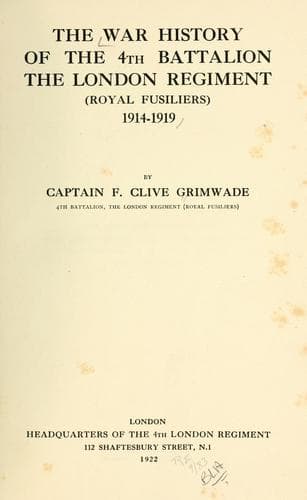
The War History of the 4th Battalion, the London Regiment (Royal Fusiliers), 1914-1919Grimwade, F. Clive
History
The War History of the 4th Battalion, the London Regiment (Royal Fusiliers), 1914-1919
Grimwade, F. Clive
Great Britain. Army. London Regiment. 4th (City of London) Battalion; World War, 1914-1918 -- Regimental histories -- Great Britain
The Battalion Orderly Room now began to be inundated by the Brigade
Intelligence Staff with plans, maps and all kinds of collated
information as to the villages which would lie in the line of the
Division's expected advance. All preparations were made for an
immediate move. Units in reserve were held in instant readiness to
advance, their first line transport wagons standing ready packed.
The night of the 16th/17th March was unusually quiet, and patrols
pushed out by the 2/1st Londons about daybreak on the 17th returned
with the information that the German trenches about Monchy were
deserted. A patrol sent forward from the 2/4th Battalion under Capt.
Bottomley was able to penetrate into Monchy itself and returned about
midday with the definite assurance that the village was evacuated.
The same day the order was given for a general advance of the whole of
the British forces from Arras to Roye.
That afternoon the 173rd Brigade moved forward, the 2/1st Londons
occupying the German front line at Monchy and some high ground south
of the village, while the 2/4th Battalion was brought forward from
Brigade reserve, "leap-frogging" through the leading Battalion to the
German trenches east of the village. A Company pushed ahead and reached
a point about 300 yards west of Adinfer Wood. Here the Battalion was
in touch with the 6th South Staffords on the right. North of Monchy
village the 2/2nd Londons continued the line with the 174th Brigade on
their left.
The withdrawal of the Germans from the Monchy Salient involved a
continual shortening of our lines as the salient became straightened
out, and in order to effect this the 2/1st Londons were withdrawn on
the night of the 17th to Pommier, while the 2/4th Battalion continued
its advance, "squeezing-out" the 2/2nd Londons as it pushed forward. By
5 p.m. the following day it had reached a position near Rabbit Wood, a
small copse on the North side of Adinfer Wood, its left being now in
touch with the 175th Brigade while the 46th Division kept pace with its
advance on the right.
At midnight on the 18th/19th March the 2/4th Londons were withdrawn in
Brigade reserve to Ransart, which village was now occupied by Brigade
Headquarters. A few hours later, at 4.30 a.m. on the 19th, the 2/1st
Londons once more took up the advance towards Boiry-Becquerelle.
The advance of the 19th March covered a depth of nearly 10,000 yards,
and as it was achieved with very little fighting it seems evident that
the Germans' preparations for withdrawal had been conducted with great
skill. From the time when they had left their original line at Monchy
they had almost entirely eluded close touch with our pursuing columns,
which were never able to harass their retirement to any useful extent.
Very little war material fell into our hands, and it seems possible
that valuable hours were lost on the 17th before the order to follow up
the retirement reached battalions in the line.
Public-domain text, read in full here on John Shaqi.
Reviews
Reviews
No reviews yet
Be the first to share your thoughts on this work.
Elsewhere in the archive
Join the Discussion
Join the discussion
Sign in to leave a comment or review.
Sign InorCreate an account