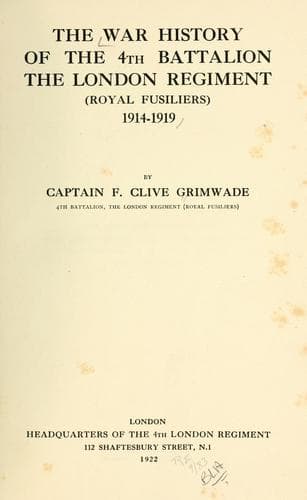
The War History of the 4th Battalion, the London Regiment (Royal Fusiliers), 1914-1919Grimwade, F. Clive
History
The War History of the 4th Battalion, the London Regiment (Royal Fusiliers), 1914-1919
Grimwade, F. Clive
Great Britain. Army. London Regiment. 4th (City of London) Battalion; World War, 1914-1918 -- Regimental histories -- Great Britain
The 169th Brigade which had left the Neuve Chapelle area in advance
of the remainder of the Division had been placed in line at Agny,
opposite Beaurains, and to this point the commanding officers of the
168th Brigade proceeded on the 17th March to make the preliminary
reconnaissance for the attack. But the following day it was found that
Beaurains was clear of enemy and was already occupied by the 169th
Brigade who were following up energetically. The reconnaissance being
no longer required the party returned to billets pending further orders.
On the 18th Lieut.-Col. A. E. Maitland, M.C. (Essex Regiment), was
appointed to command the Battalion, and on the 23rd the Division moved
forward into a concentration area in rear of Arras, the Battalion
marching from Beaudricourt at 9.30 a.m. and arriving in billets at
Beaumetz-les-Loges at 4.30 p.m. At Beaumetz the Battalion resumed its
training programme though the whole Brigade was held at short notice
to move in view of the possible further development of the enemy's
withdrawal.
It is worth while pausing for a moment to consider the extraordinary
achievement of G.H.Q. in delivering the Arras-Vimy Ridge attack as it
did on the 9th April. The preparations were on similar lines to those
for the Somme offensive of the previous July, and were on an even
vaster scale owing to the increased number of the divisions which it
was proposed to employ and to the ever-growing strength and weight of
the British artillery. The preliminary work of forming reinforcement
and concentration camps, laying fresh and increasing the capacity of
existing railway lines, arranging for water supply, dumps of munitions
and _matériel_, establishment of hospitals and the hundred and one
other essential tasks had been steadily proceeding since the close of
the Somme offensive in November 1916.
Imagine, then, the inevitable dislocation of the scheme when, a
comparatively few days before the attack was to be delivered, the
enemy suddenly withdrew on part of the front from the positions it
had been intended to assault and betook himself within fortified
lines of enormous strength to the rear. Dumps, railheads, hospitals,
water-supply, concentration areas, guns, heavy siege and light, all
had to be pushed forward to fresh and rapidly selected positions in an
area which had been laid waste with all the fiendish skill of which a
resourceful enemy was capable, and all the consequent modifications of
objectives and orders effected at the shortest possible notice. Not
only was this achieved, but it was achieved with such efficiency as to
produce on the 9th April the most striking single-day success which had
crowned the British Armies since the outbreak of the War.
Public-domain text, read in full here on John Shaqi.
Reviews
Reviews
No reviews yet
Be the first to share your thoughts on this work.
Elsewhere in the archive
Join the Discussion
Join the discussion
Sign in to leave a comment or review.
Sign InorCreate an account