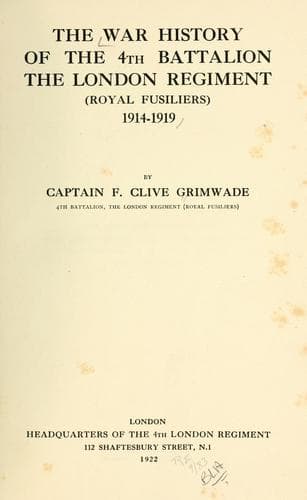
The War History of the 4th Battalion, the London Regiment (Royal Fusiliers), 1914-1919Grimwade, F. Clive
History
The War History of the 4th Battalion, the London Regiment (Royal Fusiliers), 1914-1919
Grimwade, F. Clive
Great Britain. Army. London Regiment. 4th (City of London) Battalion; World War, 1914-1918 -- Regimental histories -- Great Britain
On the 7th an inter-battalion relief was effected, the Battalion
vacating the line in favour of the Kensingtons and Rangers who were
respectively detailed as right and left assaulting battalions. The
London Scottish moved to the old British line at Agny while the 1/4th
Londons returned to dugouts in the railway cutting at Achicourt. The
following day battle positions were occupied, the London Scottish
moving forward to close support in rear of the Kensingtons, and the
1/4th Londons to Brigade reserve in the Circular Work.
The Division's objectives for the 9th April were as follows:
The 168th (left) and 167th (right) Brigades were to advance through
Neuville-Vitasse to the first objective which was an arbitrary line
(the Blue line) skirting the east edge of the village and facing the
Hindenburg system. (_Note._--The Hindenburg line between Telegraph Hill
and the Cojeul River was known as the Cojeul Switch.) This first phase
was entrusted in the 168th to the Kensingtons and Rangers, the latter
battalion on the left being prepared to adopt special measures and form
a defensive flank facing north should the 14th Division be checked at
Telegraph Hill.
After a pause on this objective of about four and a half hours the
London Scottish (168th) and 1st Londons (167th) were to "leapfrog"
through the leading troops and carry the Cojeul Switch, the Scottish
objectives being Back, Card and Telegraph Hill trenches (north of
the Neuville-Vitasse-Wancourt Road). Here a further pause was to be
made, after which the third phase of the battle would be taken up by
the 167th Brigade, who would advance, covering the whole Divisional
frontage on to the Wancourt line (Brown line).
To return to the 1/4th Battalion. The day spent in Achicourt prior to
manning battle positions produced the first serious German retaliation
to our bombardment. As already remarked Achicourt was "stiff" with
batteries and also contained a very extensive and important ammunition
dump. Doubtless the Bosche decided that the quickest way to silence
our guns was to destroy their supplies of shell, and from 11.30 a.m.
until 5 p.m. he bombarded the village, causing a good many casualties
in the Battalion and firing several houses which formed part of the
dump. The village square, moreover, was packed with lorries loaded
with shell waiting to move forward with the batteries, and unluckily
the enemy obtained some direct hits on these. For some time the flying
fragments rendered the place remarkably unhealthy. Excellent work was
done in saving two lorries by Major H. Campbell of the Kensingtons. He
well earned his D.S.O. by driving two of the blazing lorries out of the
square into a place of safety.
The battle positions occupied that night by the Battalion were as
follows:
Public-domain text, read in full here on John Shaqi.
Reviews
Reviews
No reviews yet
Be the first to share your thoughts on this work.
Elsewhere in the archive
Join the Discussion
Join the discussion
Sign in to leave a comment or review.
Sign InorCreate an account