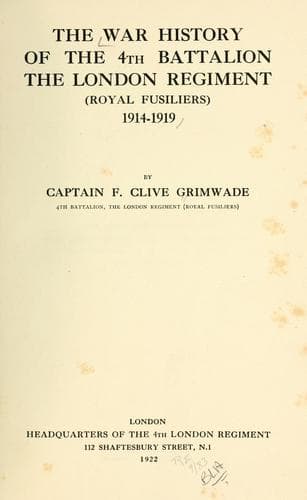
The War History of the 4th Battalion, the London Regiment (Royal Fusiliers), 1914-1919Grimwade, F. Clive
History
The War History of the 4th Battalion, the London Regiment (Royal Fusiliers), 1914-1919
Grimwade, F. Clive
Great Britain. Army. London Regiment. 4th (City of London) Battalion; World War, 1914-1918 -- Regimental histories -- Great Britain
A Company (Lorden)--New Battery Trench.
C " (Bowater)--Southend and Margate Trenches.
D " (Spiers)--Astride the Neuville-Vitasse Road in
Battery and New Battery Trenches.
Battalion Headquarters--In North End (Circular Work).
B Company (Stanbridge)--Attached as "moppers-up" to the
Kensingtons.
The role of the Battalion was laid down to provide for various
eventualities that might arise according to the degree of success
achieved by the assaulting battalions, and it was therefore held in
readiness either to assist the Rangers in forming a defensive flank in
case of failure by the division on the left, or to lend weight to the
Scottish attack on the Cojeul Switch.
At 5.30 a.m. on the 9th April, after a hurricane bombardment of the
German lines, the British barrage lifted and the attack began. The
advance of the 56th Division was deferred until two hours later to
allow the 14th Division, whose start-line was less advanced, to come
into line, and accordingly at 7.30 a.m. the Rangers and Kensingtons
moved to the assault, followed by B Company of the 1/4th Londons who
were equipped with Stokes mortar shells for dealing with deep dugouts.
B Company's job in mopping-up proved easier than had been expected, for
the German trench garrisons had been confined to their deep dugouts
for some days by the intensity of our bombardment, and the resultant
difficulties with which they had been faced in getting their rations
and water up from the rear made them on the whole not undisposed to
surrender; and in a short time the Battalion, in Brigade reserve, was
cheered by the sight of bodies of German prisoners marching in fours
down the road to Beaurains in a dazed and exhausted condition.
By 9.30 a.m. the Blue line on the whole of the Brigade front was in our
hands, and its consolidation was at once put in hand by the assaulting
troops with assistance from the 512th Company R.E. and a company of the
Cheshire Pioneers. At 11.20 a.m. the Scottish moved forward on a three
company front to attack the Cojeul Switch. Their advance was met with
heavy machine-gun fire, and although one company succeeded in gaining
Back Trench, the furthest of the three lines forming the Cojeul Switch,
and in pushing patrols beyond it, the battalion was forced ultimately
to fall back to Telegraph Hill Trench, the front line of the Switch
System and that nearest to Neuville-Vitasse.
At 12.30 p.m. the 1/4th Londons were ordered to advance to fresh
positions on the western edge of Neuville-Vitasse, where they came
under the orders of the 167th Brigade. The move was completed by 4 p.m.
with A Company in Tree, C in Leaf and D in Pine; B Company (still under
the orders of the Kensingtons) having by now withdrawn to reorganise in
Deodar Lane after their fight.
Public-domain text, read in full here on John Shaqi.
Reviews
Reviews
No reviews yet
Be the first to share your thoughts on this work.
Elsewhere in the archive
Join the Discussion
Join the discussion
Sign in to leave a comment or review.
Sign InorCreate an account