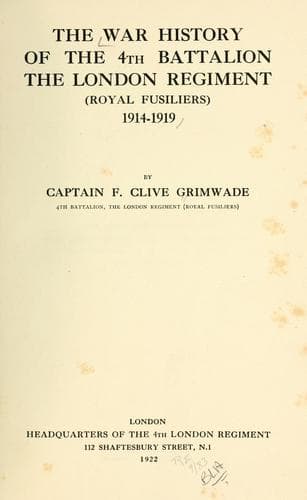
The War History of the 4th Battalion, the London Regiment (Royal Fusiliers), 1914-1919Grimwade, F. Clive
History
The War History of the 4th Battalion, the London Regiment (Royal Fusiliers), 1914-1919
Grimwade, F. Clive
Great Britain. Army. London Regiment. 4th (City of London) Battalion; World War, 1914-1918 -- Regimental histories -- Great Britain
As reports of the attack on the Cojeul Switch came in it became clear
that a gap existed between the London Scottish and the 7th Middlesex,
who had advanced to the assistance of the 1st Londons on their right,
and at 5 p.m. Brigade ordered the Battalion forward to fill this gap.
The three available companies moved forward at once, but on emerging
from Neuville-Vitasse it was found that touch had been regained by
the Scottish and the Middlesex, and the companies therefore took up a
position on the eastern edge of the village in support to the Middlesex.
In the meantime the third phase of the attack, namely, the advance of
the 167th Brigade to the Wancourt line, had been definitely checked
by machine-gun fire, as had also that of the 14th Division on the
left; so that the day's fighting ended with the 14th Division in
possession of Telegraph Hill and The Harp, and the northern end of
the Cojeul Switch; the 56th occupying the Cojeul Switch astride the
Neuville-Vitasse-Wancourt Road; and the 30th on the right approaching
the Wancourt line in the vicinity of the Neuville-Vitasse-Henin Road--a
very substantial advance for the day.
The 168th Brigade captures for the day amounted to 5 officers and
635 other ranks, all of the 163rd R. I. Regt., 9 machine-guns, 2
granatenwerfer, 1 minenwerfer, and 2 heavy trench mortars, together
with large quantities of small arms and ammunition.
In the evening the Battalion was rejoined by B Company, and Battalion
Headquarters advanced to a dugout in rear of the start-line for the
day. The night was marked by bombing operations in the Cojeul Switch
which had the wholesome effect of clearing out the few remaining
pockets of Bosche, and by 7.30 a.m. on the 10th touch had been gained
with the 14th Division on the left, while the 56th Division's right
had been extended further south and the London Scottish had possessed
themselves of the whole of the Back-Card-Telegraph Hill system.
A remarkable instance of initiative on the part of a private soldier,
which occurred on the night of the 9th April, is worth recording. Pte.
Turner, a runner of D Company, lost his company and strayed into the
German line. Finding a dugout entrance he began to descend the stairs,
when he heard voices; and as the owners of the voices were evidently
Huns he announced his arrival by throwing a Mills bomb down the dugout.
The occupants apparently thought they were outnumbered and promptly
gave themselves up to the number of 1 officer and 16 other ranks.
Turner marshalled his bag in a shell hole outside, and the next morning
was found with them, all apparently quite content to be under the
leadership of one British private, outside Neuville-Vitasse. Turner's
coolness was rewarded with the Military Medal.
Early on the 10th the weather, which had hitherto been cold and wet,
became yet worse and the landscape was soon white with snow, from which
trenches and shell holes gave no protection.
Public-domain text, read in full here on John Shaqi.
Reviews
Reviews
No reviews yet
Be the first to share your thoughts on this work.
Elsewhere in the archive
Join the Discussion
Join the discussion
Sign in to leave a comment or review.
Sign InorCreate an account