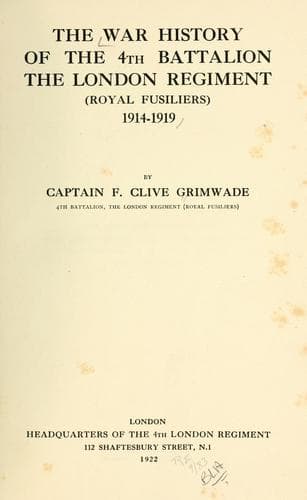
The War History of the 4th Battalion, the London Regiment (Royal Fusiliers), 1914-1919Grimwade, F. Clive
History
The War History of the 4th Battalion, the London Regiment (Royal Fusiliers), 1914-1919
Grimwade, F. Clive
Great Britain. Army. London Regiment. 4th (City of London) Battalion; World War, 1914-1918 -- Regimental histories -- Great Britain
Immediate arrangements were made by VII Corps to complete the previous
day's objectives, and an attack on the Wancourt line was delivered at
noon, the 56th Division attack being entrusted to the 167th Brigade.
During this attack the 1/4th Londons remained in support and withdrew
to their former position in the trenches on the western edge of
Neuville-Vitasse.
The assault of the 10th April was only partly successful on the Corps
front, but the pressure was maintained on the 11th. By noon on that
day the 56th Division, whose advance had developed into a flank attack
along the Hindenburg line, had cleared the Cojeul Switch as far south
as the Cojeul River and occupied the villages of Wancourt and Heninel.
While these successes had been gained south of the Scarpe an equally
striking victory had been gained north of the river where the XVII
Corps (Fergusson) of the Third Army and the Canadians (Byng) and 1
Corps (Holland) of the First Army had swept the enemy from his long
established positions on the Vimy Ridge to the plain east of it, and
had sensibly tightened our grip on the mining area of Lens.
Preparations were at once made to follow up this very striking success,
and VII Corps issued orders for the advance to be resumed on the 14th
over the watershed dividing the Cojeul valley from that of the Sensée.
The 13th was therefore devoted to preparations for this attack, in
forming advanced dumps and moving forward batteries, and the 168th
Brigade was placed under orders to advance at short notice, though no
actual move occurred during the day.
On the 14th April the enemy barrage was much heavier than it had
been on the 9th, and under a murderous fire the 169th Brigade,
which attacked on the 56th Division's front, was forced after some
initial success back to its start-line. That night the 168th Brigade
was ordered forward to form a defensive flank in the Cojeul Switch
facing north-east, and accordingly the 1/4th Battalion moved after
dark from the Back-Card-Telegraph Hill area, which they had occupied
earlier in the day, to relieve the Queen's Westminsters on the right
of the advanced line, with the London Scottish on their left and the
Kensingtons and Rangers respectively in support and reserve.
The relief was completed by 4 a.m. on the 15th with the exception of an
advanced post pushed well down the forward slope of the valley towards
Heninel. This was allotted to two platoons of B Company, but owing to
the complete devastation of the area, and the absence of landmarks,
the guides detailed to these platoons failed to find the post, and its
relief had to be postponed until the following evening.
The Battalion now experienced another change of command, and
Lieut.-Col. Maitland having fallen sick it was taken over by Major H.
Campbell, D.S.O., attached from the Kensingtons to command with the
acting rank of Lieut.-Col. as from the 12th April.
Public-domain text, read in full here on John Shaqi.
Reviews
Reviews
No reviews yet
Be the first to share your thoughts on this work.
Elsewhere in the archive
Join the Discussion
Join the discussion
Sign in to leave a comment or review.
Sign InorCreate an account