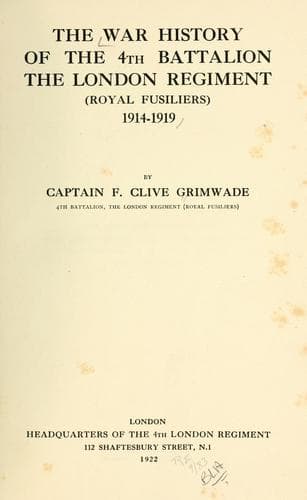
The War History of the 4th Battalion, the London Regiment (Royal Fusiliers), 1914-1919Grimwade, F. Clive
History
The War History of the 4th Battalion, the London Regiment (Royal Fusiliers), 1914-1919
Grimwade, F. Clive
Great Britain. Army. London Regiment. 4th (City of London) Battalion; World War, 1914-1918 -- Regimental histories -- Great Britain
During this period awards were made of the Military Cross to 2/Lieut.
D. S. Boorman, and of the Military Medal to L.-Corpl. Coates, for
their gallant conduct on the 15th/16th June. The Battalion was joined
on the 24th June by Capt. W. A. Stark and 2/Lieut. S. Davis, and by
drafts of 107 other ranks on the 21st June and of 28 N.C.O.'s on the
4th July. This welcome accession of strength, especially in N.C.O.'s,
who had become very few, rendered it possible once more to reorganise
the Battalion in four companies under Capts. E. N. Cotton (A), G. H.
Hetley (B), H. A. T. Hewlett (C), and A. G. Croll (D). The duties of
Intelligence Officer were taken over from Capt. Croll by 2/Lieut. S. A.
Seys, and on the 12th July, Cotton having been evacuated to hospital,
command of A Company was assumed by Capt. D. S. Boorman, M.C.
The period of rest at Logeast Wood was brought to a close by a
Battalion sports meeting, one of those quite informal but very keenly
followed affairs which always have proved such an invaluable means
of recuperation for tired troops. The following day the reorganised
Battalion was inspected by the Colonel, and on the 8th July the
Battalion marched through the devastated region and the ruins of
Courcelles, Sapignies and Bapaume to Bancourt. Its route continued
the following day to Ytres, where six days in billets were occupied
in parading for inspection successively by the Divisional General
(Fanshawe), the Brigadier (Freyberg) and the IV Corps Commander.
The Brigade was now in Divisional reserve, the Division having taken
over a sector of line in front of Gouzeaucourt and Havrincourt Wood.
The British trenches here were opposed once more to the Hindenburg
system, which had not been penetrated in this region. After severe
fighting in April round Epéhy our troops had established themselves on
high ground on the line Villers Plouich-Beaucamp-Trescault, whence a
series of spurs descend gradually in a north-easterly direction towards
Ribemont, Marcoing and the Scheldt Canal--all destined to witness
bitter fighting in the Cambrai battle five months later.
The Gouzeaucourt-Havrincourt Wood sector was now exceedingly quiet.
This, to an extent, was of great advantage to the Battalion, since
nearly 40 per cent. of its strength at the moment consisted of drafts
newly arrived who had not yet been under fire. It was possible,
therefore, for the new material to become properly assimilated into the
Battalion before further casualties created deficiencies in the ranks.
On the night 16th/17th July the 173rd Brigade took over from the 174th
Brigade the right of the Divisional front from the neighbourhood of
Villers Plouich to Queens Lane, a communication trench 500 yards west
of the Beaucamp-Ribemont Road.
Public-domain text, read in full here on John Shaqi.
Reviews
Reviews
No reviews yet
Be the first to share your thoughts on this work.
Elsewhere in the archive
Join the Discussion
Join the discussion
Sign in to leave a comment or review.
Sign InorCreate an account