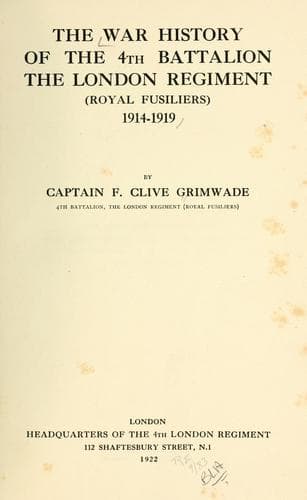
The War History of the 4th Battalion, the London Regiment (Royal Fusiliers), 1914-1919Grimwade, F. Clive
History
The War History of the 4th Battalion, the London Regiment (Royal Fusiliers), 1914-1919
Grimwade, F. Clive
Great Britain. Army. London Regiment. 4th (City of London) Battalion; World War, 1914-1918 -- Regimental histories -- Great Britain
The 2/4th Battalion remained in Brigade reserve for a few days,
Battalion Headquarters and A Company being in huts in Dessart Wood,
C and D Companies in Gouzeaucourt Wood, and B Company attached to
the 2/1st Battalion in a support trench south of Beaucamp. Daily
working parties were supplied by the Battalion for trench repair and
improvement work, but very little incident worthy of record occurred.
The principal excitement was provided by the intelligence that a German
spy disguised as an officer of the R.F.A. was in hiding in one of the
numerous woods with which the countryside is dotted, but the Battalion
was not successful in tracking him down.
The only portion of the line in which there was any degree of activity
was in front of the left of the Brigade sector, where an isolated
spinney in the middle of No Man's Land--here some 600 to 700 yards
wide--was always a target for the enemy's artillery. This spinney,
known as Boar Copse, was occupied by the Battalion in the line as an
advanced post, and it was decided to wire round the edge of the Copse
and connect it to our front line by a communication trench. The duty of
executing the work fell to the 2/4th Londons, and a working party of 4
officers and 180 N.C.O.'s and men was supplied under Capt. A. G. Croll
on the night 20th/21st July. As ill luck would have it, the Germans
selected this same evening to endeavour to raid the outpost line
occupied by the 2/9th Londons farther to the left. The raid was carried
out under an intense barrage, but our artillery answered promptly to
the call made on it and the raiders were beaten off, leaving a prisoner
in our hands. Unfortunately the raid caused a certain amount of
shelling on the Boar Copse front resulting in a few casualties, among
whom was Capt. Croll. This was exceedingly bad luck and a loss to the
Battalion. Croll had done excellent work since the arrival in France
of the 2/4th Battalion and had just received his company. His wound,
though not dangerous, was sufficiently severe to keep him in England
for almost a year. His company was taken over by Capt. C. A. Clarke.
The following night the Battalion relieved the 2/3rd Battalion in the
right subsector on a front of about 1500 yards, all the companies
being in line and each providing its own supports.
The trenches were well sited and well dug, being very deep and heavily
traversed. Throughout this area the communication trenches were
of exceptional length, Lincoln Lane in particular, which ran from
Gouzeaucourt Wood to Beaucamp, being over two miles long.
Very little incident occurred during this tour of duty. No Man's Land
was patrolled nightly and appeared to belong to us as no enemy were
encountered.
On the evening of the 30th July the Battalion was relieved by the 11th
Royal Scots and marched to the light railway at Dessart Wood, whence it
entrained to Neuville-Borjonval, camping there for the night.
Public-domain text, read in full here on John Shaqi.
Reviews
Reviews
No reviews yet
Be the first to share your thoughts on this work.
Elsewhere in the archive
Join the Discussion
Join the discussion
Sign in to leave a comment or review.
Sign InorCreate an account