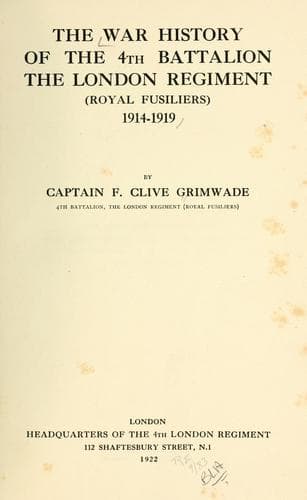
The War History of the 4th Battalion, the London Regiment (Royal Fusiliers), 1914-1919Grimwade, F. Clive
History
The War History of the 4th Battalion, the London Regiment (Royal Fusiliers), 1914-1919
Grimwade, F. Clive
Great Britain. Army. London Regiment. 4th (City of London) Battalion; World War, 1914-1918 -- Regimental histories -- Great Britain
The following day the Battalion moved by bus from Neuville to
Izel-les-Hameau, in the Arras area, the transport under Major Nunneley
moving by train from Bapaume to Saulty and then by march route to
Hameau.
The whole Division was now put through a regular course of re-equipment
and training in preparation for the heavy work it was to be called
upon to do in the offensive at Ypres. In this training particular
attention was paid to musketry, the necessity for this having been
clearly demonstrated in all recent actions, in which troops had shown
a tendency to use bombs or rifle grenades to the exclusion of their
rifles.
During this period drafts of officers were received as follows:
6th July--2/Lieut. F. A. Carlisle.
20th July--Lieut. F. S. Marsh (7th Londons); 2/Lieuts.
R. Michell (6th Londons); and H. N. Bundle, W. F.
Vines, E. R. Seabury and C. C. H. Clifford (13th
Londons).
25th July--Lieut. D. C. Cooke; 2/Lieuts. F. B. Burd
and A. J. Angel (13th Londons).
1st August--2/Lieuts. J. McDonald and F. W. Walker;
2/Lieut. C. S. Pike (7th Londons).
9th August--2/Lieut. A. S. Cook (7th Londons).
The Battalion changed its quarters on the 13th August, leaving Izel
for Denier, where it proceeded with its training. Not all the time was
devoted to work, but some excellent sports meetings were held--and
at the Brigade Sports on the 20th the Battalion was successful in
winning the Cup presented by Brig.-Gen. B. C. Freyberg, V.C., D.S.O.
The importance of achievements of this nature cannot be over-rated.
The longer the War continued the more obvious it became that if "rest"
periods were to do any good to the men at all they must be periods
of mental as well as physical rest, and games of all sorts provide
the required relaxation more than anything else. On coming out of the
trenches, weary, muddy, possibly hungry, and almost certainly wet
through, the men's first moments of freedom were spent in a game of
football.
This was an aspect of the mentality of the British soldier which we
believe was never fathomed by the French villagers. Their hospitality
and devotion to "les braves Tommys" was unfailing and genuine; but
we feel there was a lingering notion among our kind hosts that this
remarkable devotion to football was really a confirmation of the
time-honoured tradition that the English are all at least a little mad.
Reinforcements of N.C.O.'s and men were also being fed into the
Battalion during this period, and by the end of August the strength in
N.C.O.'s and men had increased by about 240.
CHAPTER XVI
THE THIRD BATTLE OF YPRES
I. _The 1/4th Battalion on the Menin Road_
Public-domain text, read in full here on John Shaqi.
Reviews
Reviews
No reviews yet
Be the first to share your thoughts on this work.
Elsewhere in the archive
Join the Discussion
Join the discussion
Sign in to leave a comment or review.
Sign InorCreate an account