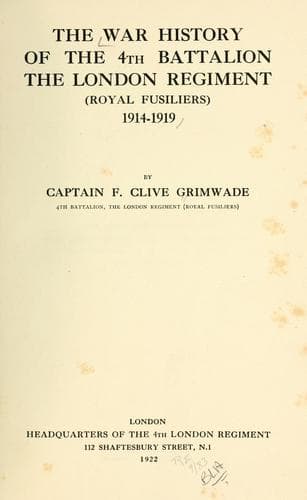
The War History of the 4th Battalion, the London Regiment (Royal Fusiliers), 1914-1919Grimwade, F. Clive
History
The War History of the 4th Battalion, the London Regiment (Royal Fusiliers), 1914-1919
Grimwade, F. Clive
Great Britain. Army. London Regiment. 4th (City of London) Battalion; World War, 1914-1918 -- Regimental histories -- Great Britain
By the middle of May 1917 the British efforts on the Arras front had
achieved the success which had been aimed at; and the offensive having
been sufficiently prolonged to assist the French in their operations
on the Chemin des Dames, the Commander-in-Chief was free to turn his
attention to the northern area of the British lines.
The first phase of the operation was opened on the 7th June, when a
brilliant attack by the Second Army (Plumer) carried the British line
forward over the Messines and Wytschaete Ridges, from which the Germans
had dominated our positions since October 1914. This operation, which
was one of the most completely successful of the whole War, resulted by
the 14th June in the advancement of practically the whole Second Army
front from the River Warnave to Klein Zillebeeke.
One by one the points of vantage held by the enemy since the beginning
of siege warfare were being wrested from his grasp. In succession the
Thiepval Ridge, the Bucquoy Ridge, the Vimy Ridge and finally the
Messines-Wytschaete Ridge had fallen into our hands, and there remained
of this long series of heights only the series of ridges which from
Zillebeeke to Passchendaele dominate Ypres on the east and north sides.
It was towards these hills that the British offensive efforts were now
directed.
The opening day of the offensive had originally been fixed for the
25th July 1917, but owing to the intensity of our bombardment the
enemy in anticipation of attack had withdrawn his guns, and the attack
was therefore postponed in order that the British guns might be
correspondingly advanced. Combined with the systematic bombardment of
the enemy's trenches, strong points and communications, a definite air
offensive which ensured our local supremacy in this respect, and also
severe gas shelling, were undertaken.
The front of attack extended for some fifteen miles from Deulemont
on the right to Boesinghe on the Yser Canal--the main attack being
entrusted to the Fifth Army (Gough) on a front of about seven miles
from the Zillebeeke-Zandvoorde Road to Boesinghe. The Second Army on
the right was to make only a limited advance with the chief objects of
widening the front of attack and distributing the enemy's resistance.
At the same time the French on the extreme left (or north) would
co-operate in the marshes of the Yser.
Public-domain text, read in full here on John Shaqi.
Reviews
Reviews
No reviews yet
Be the first to share your thoughts on this work.
Elsewhere in the archive
Join the Discussion
Join the discussion
Sign in to leave a comment or review.
Sign InorCreate an account