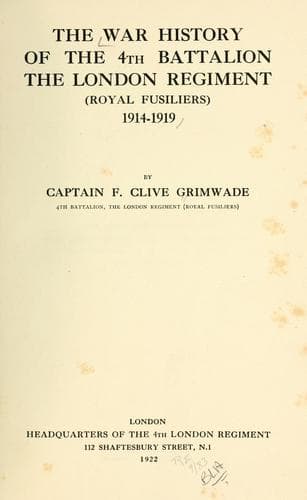
The War History of the 4th Battalion, the London Regiment (Royal Fusiliers), 1914-1919Grimwade, F. Clive
History
The War History of the 4th Battalion, the London Regiment (Royal Fusiliers), 1914-1919
Grimwade, F. Clive
Great Britain. Army. London Regiment. 4th (City of London) Battalion; World War, 1914-1918 -- Regimental histories -- Great Britain
The offensive was finally launched on the 31st July 1917. The weather,
which for a fortnight previously had been fine and dry and had seemed
to predict success, broke on the day of the battle, and a merciless
rain which changed the whole area of operations to a sea of mud fell
without cessation for several days. The Corps in line on the 31st July
were from left to right the XIV (Cavan), the XVIII (Maxse), the XIX
(Watts), the II (Jacob) and the X (Morland). On the whole the day was
one of marked success, the deepest advance being made in the northern
sector of the attack. From Westhoek to St Julien the second German
line was carried, while north of the latter village the assaulting
troops passed the second line and gained the line of the Steenbeek as
far as the junction with the French, whose attack had also met with
complete success. South of Westhoek the enemy's resistance had been
more stubborn, and his positions in Inverness Copse and Glencorse Wood
which were strongly held by machine-gun posts proved an impassable
obstacle. In this region, however, the German first line was carried,
and our troops managed to maintain themselves far enough forward on
the Westhoek Ridge to deny the enemy observation over the Ypres plain;
the position gained running almost due south from Westhoek east of the
line Clapham Junction--Stirling Castle--Bodmin Copse, and thence to
Shrewsbury Forest, south of which the German second line was occupied
as far as the Ypres-Comines Canal. South of the Canal also the Second
Army achieved considerable success.
The rain, which began to fall in the afternoon, had a most disastrous
effect on the British plan of attack. Movement over the shell-torn
ground, which was transformed into a series of bogs, rapidly became
impossible apart from a few well-defined tracks, and these naturally
became marks for the enemy's guns. The labour of moving forward
guns, relieving troops and completing the forward dumps and other
preparations for the next bound was increased tenfold. The inevitable
delay which ensued was of the greatest service to the enemy, who
thereby gained a valuable respite in which he was able to bring up
reinforcements.
The fighting of the next few days was, therefore, local in character
and consisted in clearing up the situation and improving the
British positions at various points in the line, in the course of
which operations the capture of Westhoek was completed. Numerous
counter-attacks by the enemy were successfully resisted, and the line
gained on the 31st July was substantially held.
* * * * *
Public-domain text, read in full here on John Shaqi.
Reviews
Reviews
No reviews yet
Be the first to share your thoughts on this work.
Elsewhere in the archive
Join the Discussion
Join the discussion
Sign in to leave a comment or review.
Sign InorCreate an account