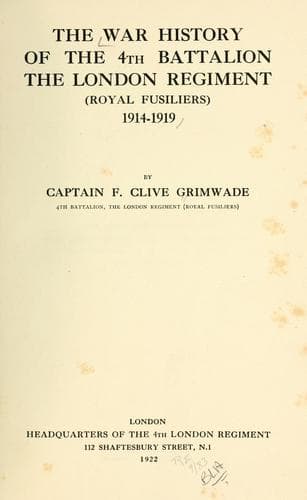
The War History of the 4th Battalion, the London Regiment (Royal Fusiliers), 1914-1919Grimwade, F. Clive
History
The War History of the 4th Battalion, the London Regiment (Royal Fusiliers), 1914-1919
Grimwade, F. Clive
Great Britain. Army. London Regiment. 4th (City of London) Battalion; World War, 1914-1918 -- Regimental histories -- Great Britain
The 56th Division moved from the Third Army area on the 24th July to
the St Omer area. The 1/4th Londons entrained at Petit Houvin for St
Omer and marched to billets at Houlle, in the Eperlecques area, some
five miles north-west of St Omer. The Division was now attached to
the V Corps. Its training was continued during the opening phase of
the battle, after which the Division moved on the 6th August to the
II Corps area, the Battalion occupying billets at Steenvoorde, where
the routine was resumed. On the 8th Major-Gen. D. Smith, C.B. (who had
commanded the Division since 24th July, when Gen. Hull fell sick), left
to command the 20th Division and, two days later, command was assumed
by Major-Gen. F. A. Dudgeon, C.B.
The same day a warning order was received that the Division would
shortly move into the line to take part in the second phase of the
battle, which was to be renewed as soon as weather conditions should
permit.
[Illustration: THE THIRD BATTLE OF YPRES, 1917 (1/4TH BATTALION)]
On the night of the 12th/13th August the Division moved forward into
the line opposite Glencorse Wood, which had been the centre of the
enemy's resistance on the first day of the battle, and took over from
portions of the 18th and 25th Divisions a sector between the Menin Road
at Clapham Junction and the cross-roads at Westhoek, the 169th Brigade
occupying the right of this front with the 167th Brigade on its left.
The 53rd Brigade of the 18th Division remained in line on the right of
the 169th Brigade, between Clapham Junction and Green Jacket Road, and
came under the orders of Gen. Dudgeon.
On the morning of the 12th the 168th Brigade in Divisional reserve
embussed at Steenvoorde for Canal Reserve Camp, Dickebusch.
The chain of machine-gun posts still held by the enemy in Inverness
Copse, Glencorse Wood and Nonne Boschen was of immense importance
to the Germans at this juncture; as they screened the long Spur
which, running north-east from the Menin Road Ridge between the
Polderhoek-Gheluvelt Ridge and the Zonnebeeke Road, formed an important
_point d'appui_ in the Langemarck-Gheluvelt line of defence. Their
capture by the British would, therefore, drive such a wedge towards the
enemy third line as to cause a serious menace to his communications
along the Menin and Zonnebeeke Roads. No one was more keenly alive to
the essential value of this position than the Germans, who spared no
efforts to frustrate attempts to launch a further attack in this area.
The continual severity of his shell and machine-gun fire against our
outpost line served his purpose well, as it not only inflicted severe
loss on the trench garrisons of the divisions in the line and seriously
impeded the task of advancing ammunition and other stores incidental
to an attack--a task already difficult enough by reason of the wet
state of the ground--but also precluded efficient reconnaissance of the
ground over which the attack was to be launched.
Public-domain text, read in full here on John Shaqi.
Reviews
Reviews
No reviews yet
Be the first to share your thoughts on this work.
Elsewhere in the archive
Join the Discussion
Join the discussion
Sign in to leave a comment or review.
Sign InorCreate an account