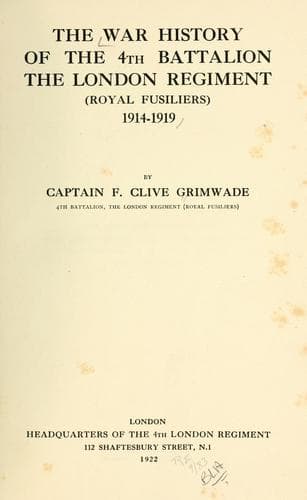
The War History of the 4th Battalion, the London Regiment (Royal Fusiliers), 1914-1919Grimwade, F. Clive
History
The War History of the 4th Battalion, the London Regiment (Royal Fusiliers), 1914-1919
Grimwade, F. Clive
Great Britain. Army. London Regiment. 4th (City of London) Battalion; World War, 1914-1918 -- Regimental histories -- Great Britain
The 56th Division was the extreme right of the attack. The advance
allotted to it was to be carried out by the 167th and 169th Brigades,
whose objective was a line beyond the third German line of defence,
and which may be roughly described as running north and south through
Polygon Wood. The southernmost point of this advance was to be Black
Watch Corner, and from this point it would be necessary to connect
the southern extremity of the final objective with the line on the
Division's right, on which no advance would be attempted. This meant
the formation of a defensive flank facing nearly south.
This vital work of forming the flank was originally entrusted to the
53rd Brigade, and the importance of their rôle will be readily grasped,
since on the manner in which it was carried out would hang in large
measure the fortunes of the 169th and 167th and successive Brigades
on the left, for the German machine-guns in Inverness Copse, if not
silenced, would be free to enfilade the whole advance. The 53rd Brigade
which had been in the line since the opening of the battle on the 31st
July was, however, now exhausted, and so seriously reduced in strength
by the tireless activity of the German machine-gunners that it was not
in a condition to renew the offensive. Its task was therefore handed
over to the 1/4th Londons, on whom devolved the difficult operation
above described of covering the right flank of the whole attack. The
only troops of the 53rd Brigade who would be actively employed would
be a detachment of the 7th Bedfords, who were made responsible for
capturing the machine-gun nests which, from the north-west corner of
Inverness Copse, dominated the whole situation.
The 1/4th Londons were detailed for this attack on the morning of the
14th August, and it is important in view of what subsequently occurred
to bear this date in mind. It must also be remembered that at this time
the Battalion was some seven miles from the field of battle and that no
officer, N.C.O. or man belonging to it had ever set eyes on the ground
over which the battle was to be fought.
During the morning Lieut.-Col. Campbell, the Adjutant and the four
company officers went forward to reconnoitre the forward area, visiting
in turn 169th Brigade Headquarters at Dormy House, and Headquarters of
the Battalion in line of the 53rd Brigade at Stirling Castle. It had
been intended also to reconnoitre the ground over which the advance was
to be made, but such was the intensity of the enemy's artillery and
machine-gun fire that this was impossible, and the company commanders
were compelled to return to their companies in ignorance of what lay
before them. Later in the day Lieut.-Col. Campbell was ordered to
report to 53rd Brigade Headquarters, but was unluckily hit on his way
back, near Zillebeeke Lake. Although badly hit he made his way back
to the Battalion, but being unable to carry on was succeeded in the
command by Major A. F. Marchment, M.C. (1/1st Londons).
Public-domain text, read in full here on John Shaqi.
Reviews
Reviews
No reviews yet
Be the first to share your thoughts on this work.
Elsewhere in the archive
Join the Discussion
Join the discussion
Sign in to leave a comment or review.
Sign InorCreate an account