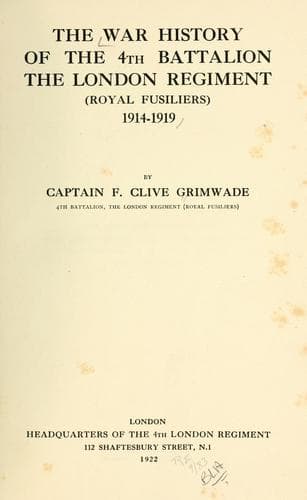
The War History of the 4th Battalion, the London Regiment (Royal Fusiliers), 1914-1919Grimwade, F. Clive
History
The War History of the 4th Battalion, the London Regiment (Royal Fusiliers), 1914-1919
Grimwade, F. Clive
Great Britain. Army. London Regiment. 4th (City of London) Battalion; World War, 1914-1918 -- Regimental histories -- Great Britain
The operation in which the 173rd Brigade was detailed to take part
was arranged for the 26th October, and consisted of an attack on a
frontage from the Ypres-Roulers Railway (south of Passchendaele) to
beyond Poelcapelle. The task of the 173rd Brigade, who were flanked
on the right by the 63rd (Royal Naval) Division and on the left by
the 57th Division, was to carry forward the British line east of
Poelcapelle for some 700 yards in a due easterly direction astride the
Poelcapelle-Westroosebeeke Road. The Divisional frontage was some 1800
yards in length, and bounded on the north by the Poelcapelle-Staden
Road and on the south by the Lekkerbotebeek. The assaulting troops
were provided by the 2/2nd, 2/3rd and 2/4th Londons, while the 2/1st
Londons were in Brigade reserve, with two battalions of the 174th
Brigade concentrated in the old German trench system near St Julien,
also at the disposal of the 173rd Brigade.
The first objective, which was on the line Spider Crossroads-Moray
House, was to be taken by the 2/2nd and 2/3rd Battalions, while after a
pause of 45 minutes, the 2/4th Londons were to "leapfrog" through them
on to the second and final objective.
As in the September action, particular preparation was made for the
assault of all known pillboxes by special parties, and the system of
posts to be established by each company was carefully and definitely
decided beforehand. The whole strength of the Battalion was necessary
to cover the wide frontage allotted to it, the order of battle from
the right being D Company (C. A. Clarke), C Company (Boorman), B
Company (Hetley) and A Company (Dickins). In addition to the stipulated
frontage the Battalion was also held responsible for some 200 yards of
waterlogged ground near the Lekkerbotebeek on its right, over which
touch with the 63rd Division could not be actively maintained.
The attack was to be delivered under a creeping barrage supported by
heavy guns, machine-guns and smoke barrages, while look-out for enemy
counter-attacks was to be maintained by aeroplanes.
On the morning of the 25th the 2/4th Londons left Siege Camp in battle
order and moved forward to positions in the original front German
system where they remained until the afternoon. At 3 p.m. the forward
move was resumed, and the Battalion was completely assembled in its
allotted area immediately east of Poelcapelle by 10.15 p.m., Battalion
Headquarters being established at Gloster Farm.
The weather had for some days past shown a marked improvement, and
the ground over which the advance was to be made was reported to be
drying fast. But our much-tried troops could not escape their usual
fate in the matter of weather, for on the night of the 25th rain fell
pitilessly once more, filling up the shell holes, liquefying the mud
and drenching everyone to the skin. All movement was rendered a matter
of extraordinary difficulty, and when the time for the attack arrived
the assaulting columns could scarcely drag themselves forward.
Public-domain text, read in full here on John Shaqi.
Reviews
Reviews
No reviews yet
Be the first to share your thoughts on this work.
Elsewhere in the archive
Join the Discussion
Join the discussion
Sign in to leave a comment or review.
Sign InorCreate an account