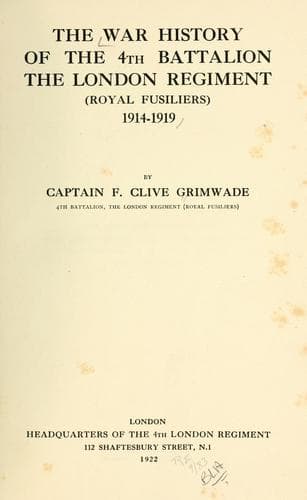
The War History of the 4th Battalion, the London Regiment (Royal Fusiliers), 1914-1919Grimwade, F. Clive
History
The War History of the 4th Battalion, the London Regiment (Royal Fusiliers), 1914-1919
Grimwade, F. Clive
Great Britain. Army. London Regiment. 4th (City of London) Battalion; World War, 1914-1918 -- Regimental histories -- Great Britain
The British front line being composed of a line of unconnected posts,
the actual "jumping-off " line was defined by tapes which made it
essential to attack before daybreak. At 5.30 a.m. the British barrage
came down, and the 2/2nd and 2/3rd Battalions followed by the 2/4th
began their laborious advance. The barrage was disappointing, for not
only was it not as well distributed as on former occasions, but, having
regard to the state of the ground, it advanced far too quickly so that
the assaulting troops were soon left far behind.
The 2/2nd Londons were successful in capturing four pillboxes of which
three were at Cameron Houses, about half-way to the first objective,
while the 2/3rd Londons on the left pushed forward to what was at
the time believed to be Spider cross-roads, but was probably a less
important road junction some 250 yards short of it. The line of this
cross-road and Cameron Houses was, however, the limit of the advance,
which was unsupported on the left owing to the adjoining division
on that flank having been held up. The only post taken by the 2/4th
Londons was Tracas Farm on the extreme right.
The men were now thoroughly exhausted by their efforts, and were
practically defenceless as the mud had choked rifles and Lewis guns,
and rendered them temporarily useless. Indeed, for over half an hour
the Battalion possessed hardly a single rifle which could be fired. At
this juncture the enemy counter-attacked in great force both at Cameron
Houses and on the unsupported left flank, and his attack, as was to
be expected in the circumstances, was successful, and our troops were
driven back with severe loss to the assembly line where the enemy's
advance was finally held.
After their rough handling of the morning it was clear that the
attacking battalions could not pursue the offensive or remain in the
line, and arrangements were accordingly made for their relief, on the
south of the Poelcapelle-Westroosebeeke Road by the 2/1st Londons and
on the north of it by the 2/7th Londons. The relief was completed by
10.15 p.m., and the 2/4th Londons returned to Siege Camp.
In other parts of the line greater success was achieved this day,
notably in the vicinity of Passchendaele where the Canadians captured
all their objectives, and on the extreme left in the area held by the
French.
The 26th October must be regarded as one of the most unfortunate days
ever experienced by the 2/4th Londons. The gallantry of officers,
N.C.O.'s and men alike left nothing to be desired, and their defeat
was at the hands of the elements far more than of the Germans. So bad
indeed was the state of the ground that not a few men, becoming stuck
in the mud and exhausted by their efforts to extricate themselves, met
their death by drowning in the flooded shell holes.
For their good work on this day decorations were awarded to Capt. C. A.
Clarke (the M.C.) and Pte C. H. W. Roberts (the D.C.M.).
Public-domain text, read in full here on John Shaqi.
Reviews
Reviews
No reviews yet
Be the first to share your thoughts on this work.
Elsewhere in the archive
Join the Discussion
Join the discussion
Sign in to leave a comment or review.
Sign InorCreate an account