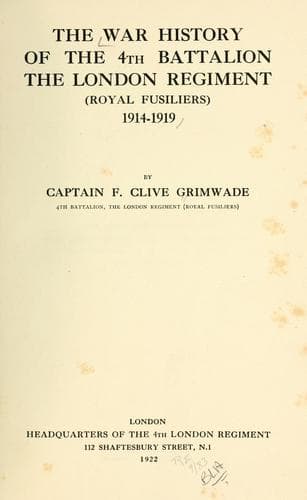
The War History of the 4th Battalion, the London Regiment (Royal Fusiliers), 1914-1919Grimwade, F. Clive
History
The War History of the 4th Battalion, the London Regiment (Royal Fusiliers), 1914-1919
Grimwade, F. Clive
Great Britain. Army. London Regiment. 4th (City of London) Battalion; World War, 1914-1918 -- Regimental histories -- Great Britain
The casualties sustained in this unfortunate affair were in officers:
2/Lieuts. F. J. Jones, H. G. Langton and J. R. Naylor, killed; 2/Lieut.
R. J. Richards, died of wounds; Capts. R. C. Dickins and D. S. Boorman,
M.C., 2/Lieuts. G. E. Lester, R. Michell, H. A. Snell and A. W. Dodds,
wounded; and in N.C.O.'s and men 25 killed, 214 wounded and 109
missing--a total of 359 all ranks. This was the most costly single day
in the history of the 2/4th Battalion.
The 2/4th Londons spent five days at Brake Camp cleaning up, resting
and reorganising, moving on the 1st November to Roads Camp, and on
the following day to St Jans-ter-biezen, about four miles west of
Poperinghe. The Battalion was now reduced to an organisation of
one company for fighting purposes, pending the arrival of further
reinforcements to fill the gaps created on the 26th October.
On the 6th November a further move was made to P Camp near Peselhoek,
north of Poperinghe, and here the Battalion remained for eight days,
all of which were occupied in training except for three working parties
of 100 N.C.O.'s and men under Capt. Hetley who proceeded to Gwent Farm
for stretcher-bearing duties.
[Illustration: _Passchendaele Ridge_]
A further attempt was made by the 175th Brigade on the 30th October to
complete the unfulfilled task of the 26th, but again the state of the
ground rendered the operation abortive. On the higher ground, however,
Canadian troops again achieved some success, and by the 6th November
had captured Passchendaele.
Thus was this stupendous offensive brought to a close. It had
been maintained for three and a half months under conditions of
unprecedented difficulty, and at enormous cost in personnel. Having
regard to the obstacles which were encountered at every step the
achievement was magnificent, and had served a definite purpose in the
War, not only by securing positions on the high ground for the winter,
but also by assisting our French and Italian Allies at a period when,
especially in the case of the latter, any operation which could relieve
the pressure on their front was of vital importance.
On the 15th November the Division was concentrated in Corps reserve,
and the 2/4th Londons moved to Piccadilly Camp in the Proven area.
The 2/4th Londons now spent a prolonged period out of the battle
area; occupying billets successively, after leaving Piccadilly Camp,
at Coulemby on the 26th November, at Bellebrune and Cremarest (about
twelve miles west of St Omer) from the 27th November to the 9th
December, and at Soult Camp near Brielen, to which the Battalion moved
on the last-mentioned date in anticipation of returning to the trenches.
Public-domain text, read in full here on John Shaqi.
Reviews
Reviews
No reviews yet
Be the first to share your thoughts on this work.
Elsewhere in the archive
Join the Discussion
Join the discussion
Sign in to leave a comment or review.
Sign InorCreate an account