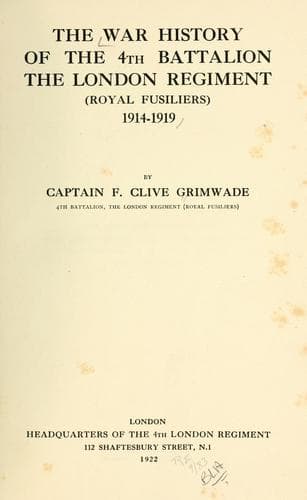
The War History of the 4th Battalion, the London Regiment (Royal Fusiliers), 1914-1919Grimwade, F. Clive
History
The War History of the 4th Battalion, the London Regiment (Royal Fusiliers), 1914-1919
Grimwade, F. Clive
Great Britain. Army. London Regiment. 4th (City of London) Battalion; World War, 1914-1918 -- Regimental histories -- Great Britain
This period of training passed with the usual routine of
"back-of-the-line" training in drill, musketry, bombing, route marching
and games, interspersed with highly welcome entertainments given by
the Divisional concert troop "The Goods." Advantage was taken of the
time spent in rest to refill the gaps in the Battalion's ranks, and an
excellent opportunity was afforded of assimilating the newly-received
drafts as they arrived and before they were called upon to go into
action. These drafts totalled 213 N.C.O.'s and men, but even with this
accession of strength the 2/4th Londons still remained considerably
weaker than prior to the recent action.
Officer reinforcements were more numerous in proportion, and included:
Lieuts. H. J. M. Williams and G. E. Lester.
2/Lieuts. R. W. Chamberlain, E. P. Higgs and L. H. Sheppard.
2/Lieut. F. B. Johnson (13th Londons).
Lieut. F. J. Griffiths, 2/Lieuts. F. E. Norrish, F. G. Williams, W.
H. G. Newman and W. Blair (20th Londons).
2/Lieuts. S. H. Jehu and J. R. Peryer (21st Londons).
Lieut. C. A. Sampson (25th Londons).
Lieuts. E. R. Howden and J. Cairns (A.S.C.).
On the 16th/17th December the 173rd Brigade took over the whole
Divisional sector, which constituted the left of the II Corps front,
from the Lekkerbotebeeke on the right to the Broembeek, a small stream
close to the Ypres-Staden Railway on the left. The Corps line was in
practically the same position as on the occasion of the Battalion's
last visit to this area, and ran roughly north and south in front of
Poelcapelle, and about 500 yards east of the Poelcapelle-Houthulst
Road. The front line, which was occupied in a series of isolated shell
hole posts, which were being strengthened and linked up to each other
as opportunity offered, was held by two battalions, with support
battalions in the captured German trenches around Langemarck and
Pilckem.
The 2/4th Battalion took over from the 2/10th Londons the left
support position in Eagle and Candle Trenches on the 16th December,
thus covering a depth of about 3500 yards. The ground between the
forward and rear companies was a quagmire of battered trenches, and
work was immediately necessary to attempt to reduce the chaos of the
defensive system to something approaching cohesion. After five quiet
days in these positions the Battalion moved forward to the left front
positions, relieving the 2/3rd Londons on the 20th December with three
companies in line and one in support. Headquarters were at Louis Farm.
With the exception of an attack against our left company which was
attempted under a severe barrage on the afternoon of the 22nd, and
which was effectually dispersed, the tour passed quietly and the
Battalion was relieved on the 24th December by the 2/10th Londons,
and concentrated at Battle Siding (Brielen), entraining there for
Elverdinghe. Casualties were 2/Lieut. Jehu and 10 N.C.O.'s and men
wounded and shell-shocked.
Public-domain text, read in full here on John Shaqi.
Reviews
Reviews
No reviews yet
Be the first to share your thoughts on this work.
Elsewhere in the archive
Join the Discussion
Join the discussion
Sign in to leave a comment or review.
Sign InorCreate an account