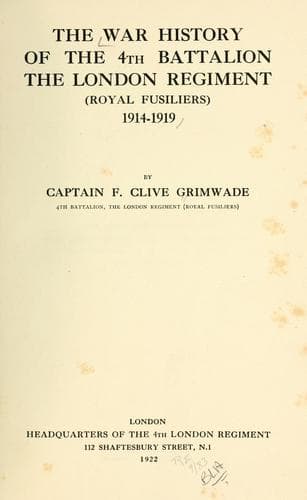
The War History of the 4th Battalion, the London Regiment (Royal Fusiliers), 1914-1919Grimwade, F. Clive
History
The War History of the 4th Battalion, the London Regiment (Royal Fusiliers), 1914-1919
Grimwade, F. Clive
Great Britain. Army. London Regiment. 4th (City of London) Battalion; World War, 1914-1918 -- Regimental histories -- Great Britain
A week at Bridge No. 1 Camp, occupied for the most part in training and
bathing, was enlivened by the Christmas festivities, for which such
provision as was possible had been made, the outstanding feature being
the production by "The Goods" of their famous pantomime, "The Babes in
the Wood," which proved an immediate and enormous success.
New Year's Day 1918 found the Battalion once more in left support
positions in Whitemill, Eagle, Bear and Candle Trenches, with
Headquarters in dugouts at Langemarck which rejoiced in the name of Pig
and Whistle. Five days of peaceful trench work here were succeeded by
an uneventful tour in the front line positions, and on the 8th January
the Battalion handed over its trenches to the 17th Lancashire Fusiliers
preparatory to the withdrawal of the whole Division. Concentrating on
relief at Bridge No. 1 Camp the Battalion moved the following day to
School Camp, Proven, where a few days' rest was obtained. The G.O.C. II
Corps here presented ribands to those who had recently been decorated.
Officer reinforcements at this period were:
27th December--2/Lieuts. P. J. Payne, N. A. Brown and
V. C. Prince.
10th January--2/Lieuts. S. F. G. Mears, E. M.
Cuthbertson, S. C. Geering and G. C. Ewing.
Early in January Lieut. D. C. Cooke went to hospital and the medical
officer, Lieut. Altounyan, M.C. (wounded), was replaced by Lieut. C. E.
Dunaway, U.S. Army.
On the 21st January the 2/4th Londons finally left the Ypres area
after nearly five months of hard work in it, and the 58th Division was
transferred to the III Corps (Pulteney) in the Fifth Army which had now
removed to the extreme south of the British lines.
In recognition of their good work in these actions, all "other ranks"
of the Battalion were subsequently granted permission to wear a small
grenade--similar to that worn as a cap badge, but smaller--on the
corners of the tunic collar.
This closes the regiment's connection with the Ypres Salient, the
scene of so much hardship and suffering, but at the same time of so
much gallantry and devotion to duty. Ypres occupies a position in the
estimation of the Empire which is challenged by no place in which
British troops served in the War; and it must be for ever a source of
pride to the regiment that it was privileged to take part in the second
and third battles for its liberation from the Germans.
CHAPTER XVIII
THE 1/4TH BATTALION IN THE BATTLE OF CAMBRAI, 1917
Public-domain text, read in full here on John Shaqi.
Reviews
Reviews
No reviews yet
Be the first to share your thoughts on this work.
Elsewhere in the archive
Join the Discussion
Join the discussion
Sign in to leave a comment or review.
Sign InorCreate an account