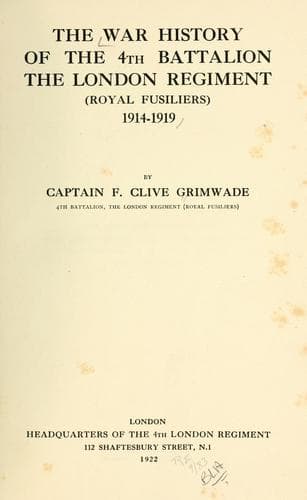
The War History of the 4th Battalion, the London Regiment (Royal Fusiliers), 1914-1919Grimwade, F. Clive
History
The War History of the 4th Battalion, the London Regiment (Royal Fusiliers), 1914-1919
Grimwade, F. Clive
Great Britain. Army. London Regiment. 4th (City of London) Battalion; World War, 1914-1918 -- Regimental histories -- Great Britain
The 30th August 1917 found the 1/4th Battalion much reduced in strength
moving from Arques to Bapaume, to the great satisfaction of all ranks,
for all had been expecting a return to the unhealthy conditions of the
Ypres Salient. On detrainment at Bapaume an evening march was made to
Beaulencourt, where quarters were allotted in a concentration camp.
This march was not without interest as it was the Battalion's first
introduction to the "devastated area," the appalling lifeless and
ruined belt of country left behind him by the Bosche in his retirement
from the Ancre-Scarpe salient to the Hindenburg line. Beaulencourt
lies between Bapaume and Le Transloy, and is thus on the ridge which
lay beyond the old Lesbœufs lines and which had proved the final check
to the Battalion's advances in the Somme battles of 1916. From the
village the Lesbœufs-Morval Ridge was visible, though of those two
ill-fated villages no ruins were discernible. The whole area was a
vast waste of rank vegetation which was rapidly covering the scars
of the previous year's battles without healing them. Shell fire had
contributed comparatively little to the desolation, but villages had
been completely demolished and trees felled, and the British troops
themselves provided the only relief to the awful silence of this
strange land from which the life of the fields had vanished.
The Battalion was now attached to the IV Corps (Woollcombe), and the
first few days were spent in very necessary reorganisation of its
slender resources in personnel. The casualties of the Ypres action were
not replaced by drafts, and each company was reduced to two platoons.
That such work as was possible was done to good purpose was shown on
the 4th September, when the Corps commander inspected the Battalion
and expressed himself gratified at the completeness and good order
of its clothing and equipment in view of its recent withdrawal from
the Flanders battlefield. This day was the third anniversary of the
Battalion's departure from England.
Between the 5th and 8th September the 56th Division took over from the
3rd the left sector of the IV Corps front. The new sector was held
with all three Brigades in line, each Brigade area being occupied with
two battalions in front trenches, one in Brigade support and one in
Divisional reserve, in positions facing the Hindenburg line from the
neighbourhood of Lagnicourt on the left to south of the Bapaume-Cambrai
Road in the vicinity of Demicourt on the right. Activity on the enemy's
part was evidently not anticipated in this area, for by this relief the
56th Division became responsible for a front of approximately 10,500
yards.
Public-domain text, read in full here on John Shaqi.
Reviews
Reviews
No reviews yet
Be the first to share your thoughts on this work.
Elsewhere in the archive
Join the Discussion
Join the discussion
Sign in to leave a comment or review.
Sign InorCreate an account