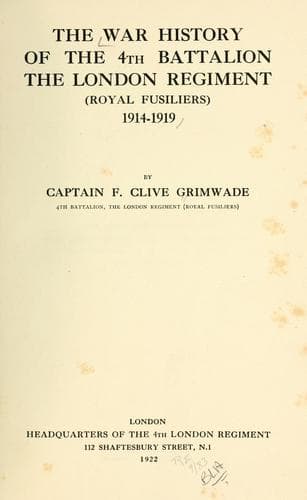
The War History of the 4th Battalion, the London Regiment (Royal Fusiliers), 1914-1919Grimwade, F. Clive
History
The War History of the 4th Battalion, the London Regiment (Royal Fusiliers), 1914-1919
Grimwade, F. Clive
Great Britain. Army. London Regiment. 4th (City of London) Battalion; World War, 1914-1918 -- Regimental histories -- Great Britain
Of this front the 168th Brigade took over the left or Lagnicourt
sector, with Headquarters in dugouts about half a mile in rear of
Lagnicourt, the Headquarters of the Division being in Frémicourt. This
sector faced the village of Quéant, which was within the defences of
the Hindenburg line. The front line of the left subsector consisted of
a series of platoon posts which were not yet connected up, numbered
respectively C 18/5, C 18/6, C 12/1, C 12/2, C 12/3 and C 12/4.
These posts were the original battle outpost positions which had
been constructed earlier in the year during the advance towards the
Hindenburg line. No Man's Land here averaged 1000 yards wide, and
though from most of these posts the enemy front line was invisible
owing to the lie of the ground, they were all, except on the left,
unapproachable from our side, except under cover of darkness. Some
500 yards in rear of this chain of defences ran a continuous trench
known as the intermediate line, well constructed, with deep dugouts,
moderately strong wire and a good field of fire. Battalion Headquarters
were in dugouts in the sunken road on the left of Lagnicourt, and were
connected with the intermediate line by a communication trench called
Dunelm Avenue. Forward of the intermediate line there was but one
trench leading to the advanced positions and this, Wakefield Avenue,
connected with Post C 18/6.
In this area the Battalion settled down very comfortably to a period
of two months' routine work in and out of the trenches, unbroken by
operations of any interest, and happily almost entirely free from
casualties. In order to avoid the tedium of following closely the
common round of duty we propose to deal with these months by means of a
few general remarks on the life of the Battalion.
During this period the Battalion was joined by the following officers:
Capt. E. E. Spicer, Lieuts. A. Bath and A. M. Duthie, and 2/Lieut.
E. L. Mills.
and by the following attached officers:
2/Lieuts. W. Shand, E. Petrie, C. W. Rowlands, and E. A. Ratcliffe
(1st Londons).
2/Lieut. A. Franks (6th Londons).
2/Lieut. W. H. Eastoe (7th Londons).
2/Lieuts. E. L. Stuckey, C. S. Richards and A. B. Creighton (17th
Londons).
2/Lieuts. F. Barnes, F. S. C. Taylor, R. S. B. Simmonds, J. L.
Backhouse and E. D. Buckland (20th Londons).
Tours of duty were six-day periods as follows:
6 days in Lagnicourt } 2 companies in posts.
left subsector } 2 " intermediate line.
6 days in Brigade support--either side of Lagnicourt village.
6 days in Lagnicourt } Dispositions as before but companies
left subsector } changed over.
6 days in Divisional reserve--at Frémicourt, and so on.
Public-domain text, read in full here on John Shaqi.
Reviews
Reviews
No reviews yet
Be the first to share your thoughts on this work.
Elsewhere in the archive
Join the Discussion
Join the discussion
Sign in to leave a comment or review.
Sign InorCreate an account