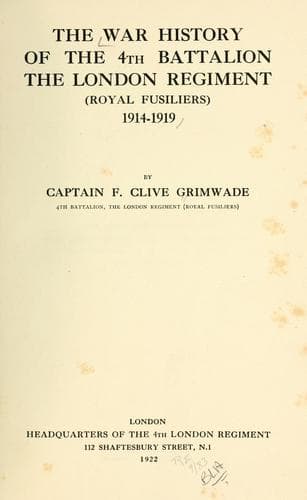
The War History of the 4th Battalion, the London Regiment (Royal Fusiliers), 1914-1919Grimwade, F. Clive
History
The War History of the 4th Battalion, the London Regiment (Royal Fusiliers), 1914-1919
Grimwade, F. Clive
Great Britain. Army. London Regiment. 4th (City of London) Battalion; World War, 1914-1918 -- Regimental histories -- Great Britain
The transport lines and Quartermaster's stores were at Frémicourt,
where permanent horse standings, kitchens, butcher's shop and stores
were erected on an elaborate scale, which appeared to suggest that all
ranks were quite prepared to settle down permanently in this unusually
pleasant sector.
In the line a very considerable amount of work was got through during
September and October. The front line posts were linked up by a
continuous traversed trench, about 7 feet deep and 3 feet wide at the
bottom, and provided with "baby elephant" shelters for the garrison.
Two embryo trenches in which forward company headquarters were
situate--Whitley and York supports--were extended and strengthened and
the intermediate line was maintained. In addition a large amount of
additional wire was put out.
While in Brigade support the Battalion always occupied shelters in the
sunken roads which ran parallel to the lines each side of Lagnicourt
village, B and D Companies being on the north side and A and C
Companies and Battalion Headquarters on the south. The dwellings here
were much improved, and fresh ones were constructed, of which the best
were one built under the supervision of Lieut. Bath and "Twin Villa" by
Headquarters. Not all the Battalion's time, however, was devoted to the
adornment of its own homes, for the support battalion was invariably
called upon to supply heavy working parties, the largest of which were
digging under the R.E.'s, while others were attached to tunnelling
companies for the construction of additional deep dugouts at trench
headquarters and in the intermediate line.
Training was not overlooked, and a great deal of valuable work was
effected. In particular mention should be made of the signallers, who
attained a very high pitch of proficiency under Lieut. Gray, while
Sergt. Randall achieved much success with the Lewis gunners, and
Sergts. Oakely and Taylor did very good work with bombers and rifle
grenadiers.
Public-domain text, read in full here on John Shaqi.
Reviews
Reviews
No reviews yet
Be the first to share your thoughts on this work.
Elsewhere in the archive
Join the Discussion
Join the discussion
Sign in to leave a comment or review.
Sign InorCreate an account