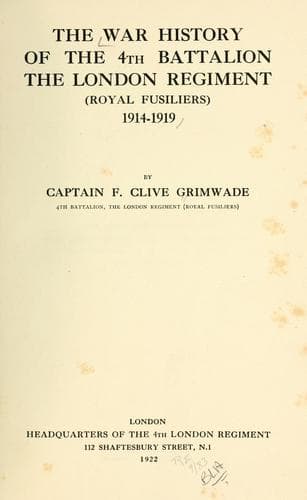
The War History of the 4th Battalion, the London Regiment (Royal Fusiliers), 1914-1919Grimwade, F. Clive
History
The War History of the 4th Battalion, the London Regiment (Royal Fusiliers), 1914-1919
Grimwade, F. Clive
Great Britain. Army. London Regiment. 4th (City of London) Battalion; World War, 1914-1918 -- Regimental histories -- Great Britain
In the line the enemy's activity on the Battalion's front was slight
and confined to occasioned shelling and trench mortaring, of which the
bulk occurred at night. The sectors right and left of the Battalion
came in for a rather greater share of the enemy's hatred. The London
Scottish on the right were immediately opposed to a network of trenches
sapped out from the Hindenburg front line, known as the Quéant
Birdcage, and in this vicinity a certain degree of bickering was always
in progress, in the course of which IV Corps developed a pleasing
habit of discharging gas projectors--about 600 at a time--against the
Birdcage. The Bosche, however, did not retaliate. It should not,
however, be supposed that the Division had settled down for a prolonged
rest in this quiet sector. Day and night our excellent artillery were
searching for--and finding--the enemy's "weak spots," and up and down
the sector No Man's Land was every night the scene of very great
patrolling activity. In this direction really useful work was effected
by the Battalion Scouts under Lieut. O. D. Garratt, M.C., and Sergts.
Housden and Hayes.
The great width of No Man's Land facilitated the operation of a novel
method of supplying the Battalion when in trenches with rations and
stores. The limbers came up nightly as usual from transport lines at
Frémicourt to trench headquarters at Lagnicourt, and from this point
the rations were sent up to company headquarters in half limbers and on
pack mules; whereby a considerable saving of troops for work elsewhere
was effected. On one of these nightly journeys a bridge over Wakefield
Avenue broke and precipitated an elderly transport horse, named Tommy,
on to his back in the trench. It was two hours' hard work to dig room
round him to get him up and make a ramp for him to walk out of the
trench! Tommy's mishap was commemorated in the new bridge which was
named Horsefall Bridge.
A nasty accident in the line was averted by the coolness of Pte.
Bunker, A Company. While a section was cleaning some Mills bombs one
of the pins fell out and the bomb, with the fuse burning, fell among
the men. Bunker picked it up and threw it out of the trench, when it at
once exploded. For this action Bunker was awarded the M.S.M.
In the first week of October, while the Battalion was in line, a series
of heavy explosions was heard behind the enemy line in the vicinity of
Quéant and Pronville and these, combined with the sudden disappearance
one night of Baralle chimney--a well-known observation point in the
enemy's country--conduced to the belief, which held sway for a few
days, that a further Bosche retirement was imminent. This, of course,
did not materialise.
Although we are not recording the actions of the Divisional Artillery
we may, perhaps, be pardoned for quoting the following crisp little
record from the Divisional Intelligence Summary as illustrating how
well the infantry was served by its guns. The incident occurred on the
10th October:
Public-domain text, read in full here on John Shaqi.
Reviews
Reviews
No reviews yet
Be the first to share your thoughts on this work.
Elsewhere in the archive
Join the Discussion
Join the discussion
Sign in to leave a comment or review.
Sign InorCreate an account