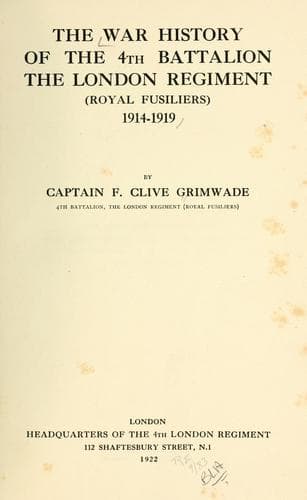
The War History of the 4th Battalion, the London Regiment (Royal Fusiliers), 1914-1919Grimwade, F. Clive
History
The War History of the 4th Battalion, the London Regiment (Royal Fusiliers), 1914-1919
Grimwade, F. Clive
Great Britain. Army. London Regiment. 4th (City of London) Battalion; World War, 1914-1918 -- Regimental histories -- Great Britain
Movement was seen at an O.P. or sentry post about D.7.d.4.6. An
18-pr. opened fire, but the first shot fell a few yards wide,
whereupon the German observer waved a "washout" signal with a piece
of white paper. The second shot, however, altered his opinion of
our artillery.
His amended opinion has, unfortunately, not been recorded.
The losses of the Battalion in personnel up to the end of October
were practically nil, this being accounted for by the vastness of the
terrain and the fact that about 450 men were occupying some 5000 yards
of firing and communication trench. On the 28th October, however, the
Battalion had the misfortune to lose two promising young officers,
2/Lieuts. Elders and Barnes, both of whom were killed by shells during
an enemy shoot on Posts C 12/3 and C 12/4.
During this period also the Battalion sustained a great loss in
Regimental Sergt.-Major M. Harris, who took his discharge after nearly
twenty-three years of soldiering in the Royal Fusiliers and the 4th
Londons. Sergt.-Major Harris had served continuously with the 1/4th
Battalion since mobilisation, and had filled the position of Senior
Warrant Officer with conspicuous success since March 1915. The last
member of the pre-war permanent staff to remain on active service with
the Battalion, Harris' imperturbable geniality was the means of adding
enormous force to his disciplinary strictness. His share in achieving
the Battalion's efficiency can hardly be over-rated, while his kindly
personality was ever a factor in the social life of the Battalion.
Harris was gazetted Lieutenant and Quartermaster to the Battalion in
the reconstituted Territorial Army in July 1921. The duties of R.S.M.
in the 1/4th Battalion were taken by C.S.M. Jacques.
At the end of October information was circulated among commanding
officers that active operations were imminent. The secrets of the
operations were jealously guarded, and only a vague idea was given as
to what would be the opening day. On the 10th November, however, orders
were issued for a feint attack to be delivered by the 56th Division,
which would be on the left of the main operation. This feint was to
be accompanied by a heavy bombardment by all available batteries, by
a smoke screen and the display of dummy figures over the parapet.
Dummy tanks were also to be erected in No Man's Land, and the illusion
completed--or anyway increased--by running motor cycle engines in the
front line trenches. Arrangements for this demonstration were pushed
on with vigour, and it was understood that Z day would fall during the
Battalion's occupancy of the line.
On the evening of the 18th, however, the 167th Brigade extended to its
left, taking over the 168th sector, and thus holding a two-brigade
front. The 168th Brigade was concentrated in close billets in
Frémicourt and Beugny, the Battalion being in the former village.
* * * * *
Public-domain text, read in full here on John Shaqi.
Reviews
Reviews
No reviews yet
Be the first to share your thoughts on this work.
Elsewhere in the archive
Join the Discussion
Join the discussion
Sign in to leave a comment or review.
Sign InorCreate an account