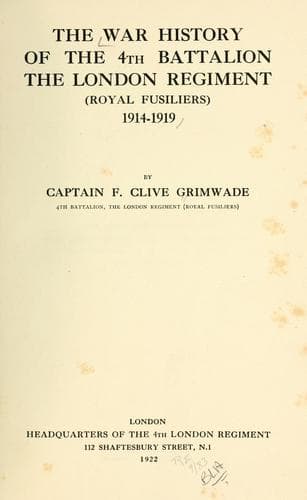
The War History of the 4th Battalion, the London Regiment (Royal Fusiliers), 1914-1919Grimwade, F. Clive
History
The War History of the 4th Battalion, the London Regiment (Royal Fusiliers), 1914-1919
Grimwade, F. Clive
Great Britain. Army. London Regiment. 4th (City of London) Battalion; World War, 1914-1918 -- Regimental histories -- Great Britain
The preparations for the offensive were conducted with the greatest
possible secrecy, and in order to secure the maximum surprise effect
it was arranged for the attack to be delivered without any preliminary
bombardment or even registration of batteries, the road into the
enemy's defences being cleared instead by a vast number of tanks.
The attack was delivered by the IV (Woollcombe) III (Pulteney) and
VII (Snow) Corps, on a six-mile front, between Hermies and Gonnelieu,
a subsidiary operation being conducted north of Bullecourt by the VI
Corps (Haldane). The 56th Division was thus outside the actual area of
advance, but was to co-operate on the opening day by means of the feint
attack, for which it had already made preparations, and its further
action was to depend on the success gained in the main operation. The
left flank of the area of advance was intersected by the Canal du Nord,
running between Bourlon and Mœuvres. The frontage in this region was
taken up by the 36th (Ulster) Division, which adjoined the right flank
of the 56th and was the left of the whole attack. The 36th was to
attack with two brigades east of the Canal and one brigade west, the
Division moving northwards along the Hindenburg system towards Mœuvres.
The rôle of the 56th Division was to depend on the degree of success
attained by the 36th. If the latter's attack succeeded in forcing the
retirement of the enemy west of the Canal, this area would be occupied
by the brigade of the 36th Division which was on the west bank; if,
however, this success was not achieved the 56th Division was to attack
over the open with tanks, the 169th Brigade advancing on a front
between Mœuvres and Tadpole Copse, and the 167th forming a defensive
flank from the Copse to our present front line.
The enormous success which attended the initial stages of the Cambrai
battle needs no elaboration here. At 6.30 a.m. on 30th November
the dead silence was suddenly broken by the roar of a very great
concentration of batteries of all calibres up to 15-inch, and preceded
by 380 tanks the assaulting divisions swept over the first and second
systems of the Hindenburg line.
With the exception of a check due to the destruction of the Canal de
l'Escaut Bridge at Masnières, and of another at Flesquières (where
a most gallant resistance to the 51st Division was put up by a
single German officer, who continued to serve his gun after all the
team were killed and succeeded in knocking out several tanks), the
success of the day was considerable. The villages of Havrincourt,
Graincourt, Ribecourt, Marcoing and La Vacquerie were added to the
British territory, and it was obvious that the surprise effect had been
complete.
On the left the 36th Division established itself north of the Cambrai
Road, astride the Hindenburg line, and the 169th Brigade swung its
right flank northward to conform to its neighbours' movements.
Public-domain text, read in full here on John Shaqi.
Reviews
Reviews
No reviews yet
Be the first to share your thoughts on this work.
Elsewhere in the archive
Join the Discussion
Join the discussion
Sign in to leave a comment or review.
Sign InorCreate an account