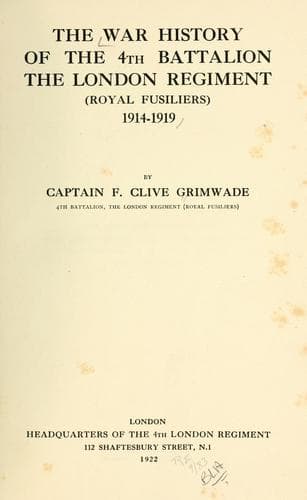
The War History of the 4th Battalion, the London Regiment (Royal Fusiliers), 1914-1919Grimwade, F. Clive
History
The War History of the 4th Battalion, the London Regiment (Royal Fusiliers), 1914-1919
Grimwade, F. Clive
Great Britain. Army. London Regiment. 4th (City of London) Battalion; World War, 1914-1918 -- Regimental histories -- Great Britain
At 11.30 p.m. on the 26th the Battalion was relieved by the
Kensingtons, withdrawing on relief to its former position in the
Brigade support area behind the old British front line. This relief
brought to a close the Battalion's active participation in the British
offensive, which was now practically spent. During the very trying
three days spent behind the bombing blocks in circumstances which
required particular vigilance and fortitude, all ranks had behaved
splendidly, and it is difficult to mention individuals when all had
rendered such excellent service. A few names, however, call for
outstanding mention, among these being Capt. S. J. Barkworth, M.C.,
M.M., and Capt. A. M. Duthie, the commanders of C and D Companies, on
whom the brunt of the work had fallen, and their subalterns Rowlands
and Mills. The Padre, the Rev. S. F. Leighton Green, did splendid
service throughout, being always about the Hindenburg lines and going
up to the advanced blocks. At night he was constantly visiting and
helping with casualties and administering the last rites to those who
had fallen.
The whole action as far as the Division was concerned had developed on
lines completely opposed to the original plans; for whereas it had been
proposed to employ the Division in the open with tanks, its fighting
throughout had been hand-to-hand fighting in trenches. The regularity
and sufficiency with which bomb supplies found their way to the front
indicated excellent organisation. At no time did supplies fall short of
the demand.
It was a surprise to a good many to find the much vaunted Hindenburg
line inferior to our own defences. The outpost line which the companies
first occupied was a gross delusion, for it was only six inches deep,
while the main line was poor and not over well maintained, and the
Bosche ideas of sanitation could only be described as a scandal.
The casualties sustained during the three days' fighting were light in
view of the close contact with the enemy. Two officers, 2/Lieuts. R. S.
B. Simmonds and E. Petrie, were wounded, and the total losses in other
ranks amounted to about 60, including two valuable N.C.O.'s killed,
viz.: Sergts. Barker and Gooch, and one, Sergt. Lintott, M.M., wounded
and captured.
Public-domain text, read in full here on John Shaqi.
Reviews
Reviews
No reviews yet
Be the first to share your thoughts on this work.
Elsewhere in the archive
Join the Discussion
Join the discussion
Sign in to leave a comment or review.
Sign InorCreate an account