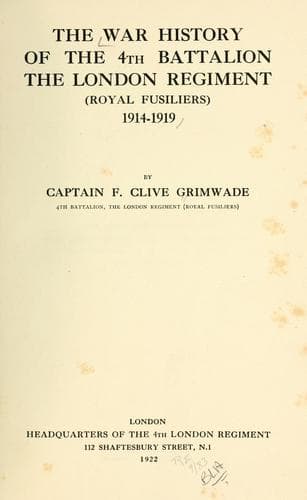
The War History of the 4th Battalion, the London Regiment (Royal Fusiliers), 1914-1919Grimwade, F. Clive
History
The War History of the 4th Battalion, the London Regiment (Royal Fusiliers), 1914-1919
Grimwade, F. Clive
Great Britain. Army. London Regiment. 4th (City of London) Battalion; World War, 1914-1918 -- Regimental histories -- Great Britain
The advantage of having the Battalion compacted in one camp became
almost at once exemplified, and the desirable tightening of discipline
rapidly effected a great increase of efficiency. The unsurpassed
facilities for training afforded by the Aldershot Command also proved
of incalculable value, and enabled the keen and efficient training
staff of the Battalion to raise the unit to the position of one of the
best organised battalions of a Brigade whose reputation for training
was second to none.
At Blackdown, moreover, the facilities provided for the recreation
of the troops were really excellent, and among these mention should
be made first of the Y.M.C.A. and the Church Army, whose excellent
institutions were of the greatest value. Each battalion also was
provided with a sports ground, and among the pleasant memories of
men trained in this Station not the least is the Blackdown Garrison
Theatre, which was visited weekly by capable companies. The Sunday
evening concerts in the theatre were also a very notable and valuable
feature of the social life of the garrison.
Training here proceeded on the same lines, but a further modification
was now introduced for the benefit of the large numbers of lads under
military age who were now joining. Under the Military Service Acts
no men might be sent overseas till the age of nineteen, and in order
to ensure that their training should not be unnecessarily hurried a
special syllabus of work was evolved for them, the original scheme
being so enlarged and lengthened as to provide for such young soldiers
becoming "trained" not earlier than the age at which they might be sent
to the front. To ensure the smooth working of this amended scheme
the young soldiers, or "A IV's" as they were called, were grouped
in special companies, and in addition a number of "young soldier
battalions" were added to the Coastal Defence Forces.
In January 1918 Lieut.-Col. Montgomerie Webb vacated command of the
Battalion on attachment to the Royal Air Force, and the Battalion
was taken over by Lieut.-Col. Hanbury Sparrow, D.S.O., M.C., Royal
Berkshire Regiment, who had come to England under the six months
exchange system. Under Lieut.-Col. Sparrow the Battalion continued
to make great strides, and his striking personality was the means of
winning every ounce of willing and devoted service from all who had
the honour to be under his command. The work of the Reserve Battalion
during the early part of 1918 is so much bound up with the movements of
the overseas battalions under the stress of the German offensive that
we may conveniently break off here and take up the story of the Second
Battle of the Somme.
CHAPTER XX
THE 2/4TH BATTALION IN THE SECOND BATTLE OF THE SOMME, 1918
I. _Preparations for the German Offensive_
Public-domain text, read in full here on John Shaqi.
Reviews
Reviews
No reviews yet
Be the first to share your thoughts on this work.
Elsewhere in the archive
Join the Discussion
Join the discussion
Sign in to leave a comment or review.
Sign InorCreate an account