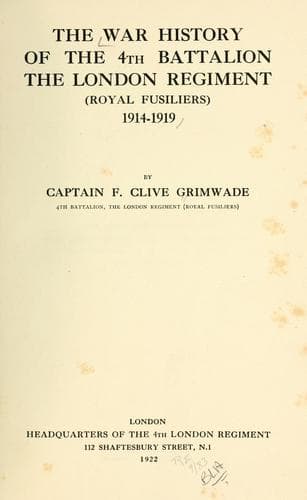
The War History of the 4th Battalion, the London Regiment (Royal Fusiliers), 1914-1919Grimwade, F. Clive
History
The War History of the 4th Battalion, the London Regiment (Royal Fusiliers), 1914-1919
Grimwade, F. Clive
Great Britain. Army. London Regiment. 4th (City of London) Battalion; World War, 1914-1918 -- Regimental histories -- Great Britain
The Vouel line was now the most advanced position, and at 6.30 p.m.
the Headquarters of the 3rd, 2/4th and 8th Londons were withdrawn from
it to Noureuil. The night passed without any further attempt on the
enemy's part to advance, and on our side a good deal of patrolling
activity took place. This led to several encounters with small parties
of enemy, and resulted in the collection of a quite useful bag of
German prisoners as well as a machine-gun and team. Under cover of
darkness also touch was regained with the Condren garrison.
Information was received on the evening of the 22nd that French troops
were rapidly advancing to our assistance, and that they would be ready
to counter-attack the next morning with the object of retaking the
Crozat Canal line.
On the 23rd March mist appeared yet once more, considerably hampering
our defence and giving the enemy an opportunity of massing for attack.
Shortly after 8 a.m. the French attack was launched by two battalions
of the 125th French Infantry which passed forward through the Vouel
line. The result of the attack is not definitely known as it was
impossible to see beyond a radius of about 15 yards. It is certain,
however, that it failed to reach Tergnier, and by 11 a.m. the French
advance was broken and the troops beginning to drift back into our
lines. It should be pointed out in fairness to our Allies that they had
been rushed up into the line, incomplete in equipment and transport,
and that they were called on to operate without previous reconnaissance
over ground which was shrouded in mist and unknown to them. On the
extreme left the withdrawal was conducted in some disorder, and it was
reported that the 18th Division on our left was also being forced back
through Frières Wood. The Vouel line, unfinished and shallow as it was,
was already occupied to its fullest capacity, and the French falling
back on it caused considerable congestion in the well-dug parts. About
the same time the German artillery, which had been plastering the Vouel
line fairly steadily all the morning, lifted, and was at once succeeded
by an accurate and intense machine-gun barrage. This further tended to
create difficulty in the position, for in view of the congestion of the
trench it became very hard to get orders along, while work on the gaps
between the well dug portions was almost impossible.
Public-domain text, read in full here on John Shaqi.
Reviews
Reviews
No reviews yet
Be the first to share your thoughts on this work.
Elsewhere in the archive
Join the Discussion
Join the discussion
Sign in to leave a comment or review.
Sign InorCreate an account