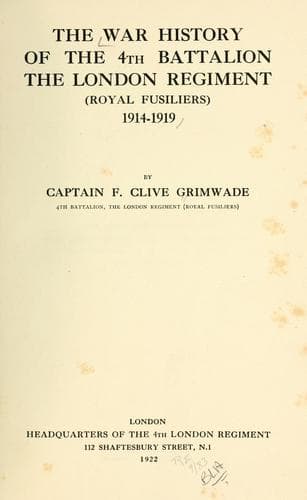
The War History of the 4th Battalion, the London Regiment (Royal Fusiliers), 1914-1919Grimwade, F. Clive
History
The War History of the 4th Battalion, the London Regiment (Royal Fusiliers), 1914-1919
Grimwade, F. Clive
Great Britain. Army. London Regiment. 4th (City of London) Battalion; World War, 1914-1918 -- Regimental histories -- Great Britain
The tower of Richebourg church still proved a great attraction to the
enemy's heavy guns, and the village was daily subjected to severe shell
fire during daytime. On 21st March it became evident that the Germans
were determined to destroy the church tower, and a steady bombardment
with heavy shells began, which caused infinite damage to the church
itself and the surrounding houses. During this bombardment a direct
hit was obtained on a billet occupied by a platoon of Highland Light
Infantry, causing casualties of 12 killed and 30 wounded. Later three
direct hits were registered on the church tower, which fell about noon,
and this achievement was followed by a complete cessation of hostile
fire, which indicated sufficiently clearly what the intention of the
bombardment had been.
All ranks of the Battalion were now settling down to their duties
in the trenches, showing great keenness to increase their value as
fighting troops and exhibiting the greatest steadiness under the
numerous heavy bombardments to which they had been exposed, and it was,
therefore, gratifying to receive a word of appreciation as to their
behaviour from the Divisional Commander during a visit which he paid to
Battalion Headquarters on the 17th.
The Battalion was now again under command of Lieut.-Col. G. P.
Botterill, and Major L. T. Burnett resumed his duties as second in
command.
On the 17th also a further reinforcement of officers was received as
follows:
Major E. H. Stillwell and 2/Lieuts. E. P. M. Mosely and F. F. Hunt.
The Machine-Gun and Trench Mortar Sections were now carrying out their
full duties in the front trenches, and did exceedingly good work during
this tour, which, for the latter section, was their first experience of
working their mortars in action. During the bombardment of the 19th,
2/Lieut. J. T. Sykes, in charge of the trench mortars, was wounded by
shrapnel while "spotting" for a mortar shoot, and evacuated to hospital.
On the night of the 23/24 March the relief of the Ferozepore Brigade
by the 2nd Brigade began, and the forward garrisons of the 4th London
being withdrawn, the Battalion on the following evening marched back
to billets at Paradis, a small village near Merville. The Connaughts
were relieved in the line on the following night, and the Brigade being
concentrated in the Paradis area came into Army Reserve at two hours'
notice to move.
The total casualties sustained by the Battalion during this tour of
trench duty were 17, a very small number having regard to the severity
of the bombardments to which it had been subjected.
From the 26th March until the 2nd April, Lieut.-Col. Botterill was in
temporary command of the Brigade during the absence on leave of the
Brigadier; and command of the Battalion for this period was assumed by
Major G. H. M. Vine.
Public-domain text, read in full here on John Shaqi.
Reviews
Reviews
No reviews yet
Be the first to share your thoughts on this work.
Join the Discussion
Join the discussion
Sign in to leave a comment or review.
Sign InorCreate an account