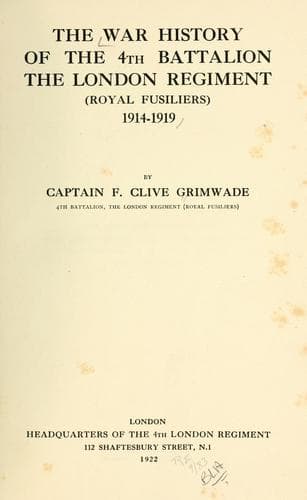
The War History of the 4th Battalion, the London Regiment (Royal Fusiliers), 1914-1919Grimwade, F. Clive
History
The War History of the 4th Battalion, the London Regiment (Royal Fusiliers), 1914-1919
Grimwade, F. Clive
Great Britain. Army. London Regiment. 4th (City of London) Battalion; World War, 1914-1918 -- Regimental histories -- Great Britain
The sector now taken over extended from Chocolat Menier Corner on the
right to Port Arthur on the left, and during the tour proved to be
fairly quiet, except in the left subsection held by the Connaughts,
where two strong points, Port Arthur and the Orchard Redoubt, and also
the Crescent Trench, a circular trench connecting them, were daily
subjected to heavy bombardments.
The 4th Londons in reserve provided garrisons for the forward area as
follows:
D Company (Cart de Lafontaine) to the Orchard Redoubt, which it
held in company with a party of the Connaughts.
One Platoon of each of A, B and C Companies to the left subsection,
under instruction in trench warfare by the Connaughts.
Two Platoons each of B and C Companies (Moore and Vine) to Redoubts
D5 and D6 respectively. These redoubts were close to Windy
Corner on Forresters Lane, and were subsequently known as Dogs
and Edward Posts.
Machine-Gun Detachment to Port Arthur Keep, and Trench Mortar
Section to the left subsection.
The platoons under instruction were relieved every forty-eight hours
in order to ensure that during the tour of duty the companies were all
given a certain amount of trench experience. The remaining platoons,
not for the moment employed in garrison duty, were billeted with
Battalion Headquarters in Richebourg, and provided working and carrying
parties each night for the line.
The line was still not fully organised after the battle, and the
Crescent Trench was not properly connected either to the Orchard on
its right or to Port Arthur on the farther side of the La Bassée Road
on its left; and as the construction of communication trenches in this
area had not yet been seriously undertaken, the various companies
holding those works were isolated during the hours of daylight, as were
also the detached listening posts pushed forward in front of them into
No Man's Land. There was thus a very considerable amount of trench work
required to bring the defences to a proper state of organisation and
also in the completion of the wire entanglements in front of the new
advanced line, and the 4th Londons were called upon for heavy duties in
this direction in conjunction with the Sappers and Miners.
Public-domain text, read in full here on John Shaqi.
Reviews
Reviews
No reviews yet
Be the first to share your thoughts on this work.
Join the Discussion
Join the discussion
Sign in to leave a comment or review.
Sign InorCreate an account