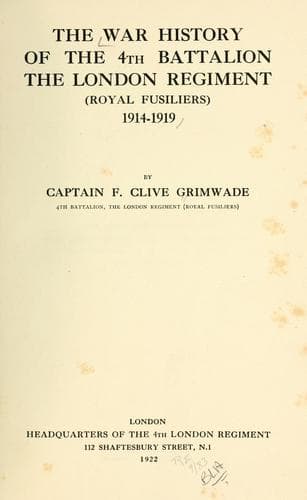
The War History of the 4th Battalion, the London Regiment (Royal Fusiliers), 1914-1919Grimwade, F. Clive
History
The War History of the 4th Battalion, the London Regiment (Royal Fusiliers), 1914-1919
Grimwade, F. Clive
Great Britain. Army. London Regiment. 4th (City of London) Battalion; World War, 1914-1918 -- Regimental histories -- Great Britain
This was the only occasion on which either Battalion of the regiment
was called on to face tanks. There can be no question as to the
tremendous moral effect of these machines, though their actual
destructiveness--handled as they were--was not great. Under the
conditions of mist which prevented any warning of their approach,
and the conglomerate composition of the Battalion, a little initial
unsteadiness on the part of the less trained elements of the Battalion
was almost to be expected in face of such an ordeal. The rapid recovery
and steady rearguard fight back to the Cachy line, however, showed that
after the first shock the innate discipline of the Londoner asserted
itself and the number of enemy dead counted on the field was evidence
of the heavy cost to the Germans of their success.
2/Lieut. Ewing should be mentioned. "His behaviour was splendid
throughout. During the preliminary bombardment he was constantly up
and down his sector encouraging his men, and when the enemy ultimately
appeared his fire orders were clear and effective." He was awarded the
M.C., as was also Capt. Morton, who displayed throughout the day marked
qualities of leadership and coolness. Pte. Petrie, a stretcher-bearer
who gained the M.M., exhibited an utter disregard of personal danger in
pursuing his work of bringing in and tending wounded.
The heavy casualties sustained this day in "missing" were due to the
fact that in retirement the Battalion was forced to leave many men, who
might otherwise have been saved, in the enemy's hands. But the R.A.M.C.
staff under Lieut. Dunaway worked magnificently under heavy shell fire
till the last moment, thereby retrieving many wounded men who must
otherwise have been captured.
We have already pointed to the great importance of Villers-Bretonneux
in the defence of Amiens, and it is not surprising therefore that its
loss was followed by an immediate order from Army Headquarters that it
must be recaptured at all costs.
The counter-attack was delivered at 10 p.m. on the 24th April by the
9th Londons, the 54th Brigade and the Australians. Villers-Bretonneux
again passed into our hands, while on the 58th Division's front the
line was advanced about half-way forward from the Cachy Switch to the
original front line.
During the 25th April the 2/4th Battalion was not engaged, though it
was all day long subjected to severe artillery fire, which inflicted a
good many casualties. On the evening of the 25th the 2/4th Battalion
was relieved by troops of the French Moroccan Division, and withdrew on
relief to bivouacs in open country east of Boves.
The casualties of the two days' action were:
2/Lieut. J. W. Booking, killed; Capts. S. G. Askham, M.C., B. H. C.
Hettler, M.C., 2/Lieuts. S. F. G. Mears, P. J. Payne and L. H.
Sheppard, wounded; 2/Lieuts. S. C. Geering and C. W. Cumner,
missing; and in N.C.O.'s and men 23 killed, 108 wounded and 203
missing.
Public-domain text, read in full here on John Shaqi.
Reviews
Reviews
No reviews yet
Be the first to share your thoughts on this work.
Elsewhere in the archive
Join the Discussion
Join the discussion
Sign in to leave a comment or review.
Sign InorCreate an account